
The phrase ‘From the cradle to the grave’ was popularised by Winston Churchill, the British Prime Minister, in 1943 to describe the ambition of a welfare state that would provide security from birth to death.
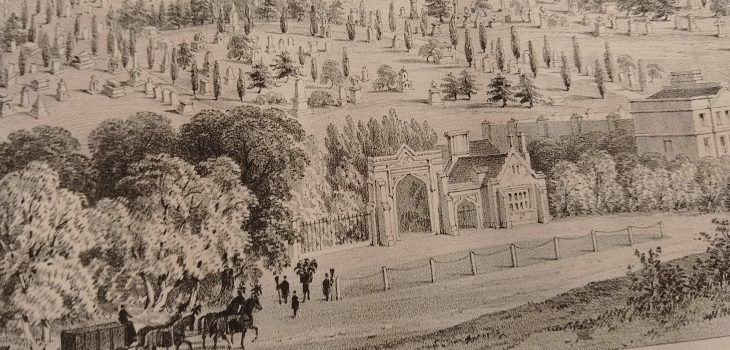
With the School’s mission supporting the aims of a national health service, it is not surprising to find in its historical collections the first book to describe the planning and design of cemeteries in England: On the laying out, planting, and managing of cemeteries published in 1843. The author, John Claudius Loudon (1782-1843) was a leading British horticulturist who also designed houses with spacious, landscaped gardens for the middle classes, promoting his strong belief in the benefits to health and enjoyment that access to outside spaces brought.
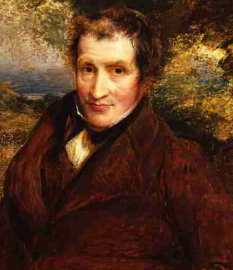
The last direction Loudon’s career took was the creation of cemeteries now urgently needed across the country as graveyards became full. Loudon’s book was written because of his own practical experience designing cemeteries and long after a tour of Europe in 1813, where he had taken note of the different styles of burial grounds adopted in the countries he travelled through from Stockholm to Naples. Illustrations of some of these are included in the book, as are plans for layouts of plots.
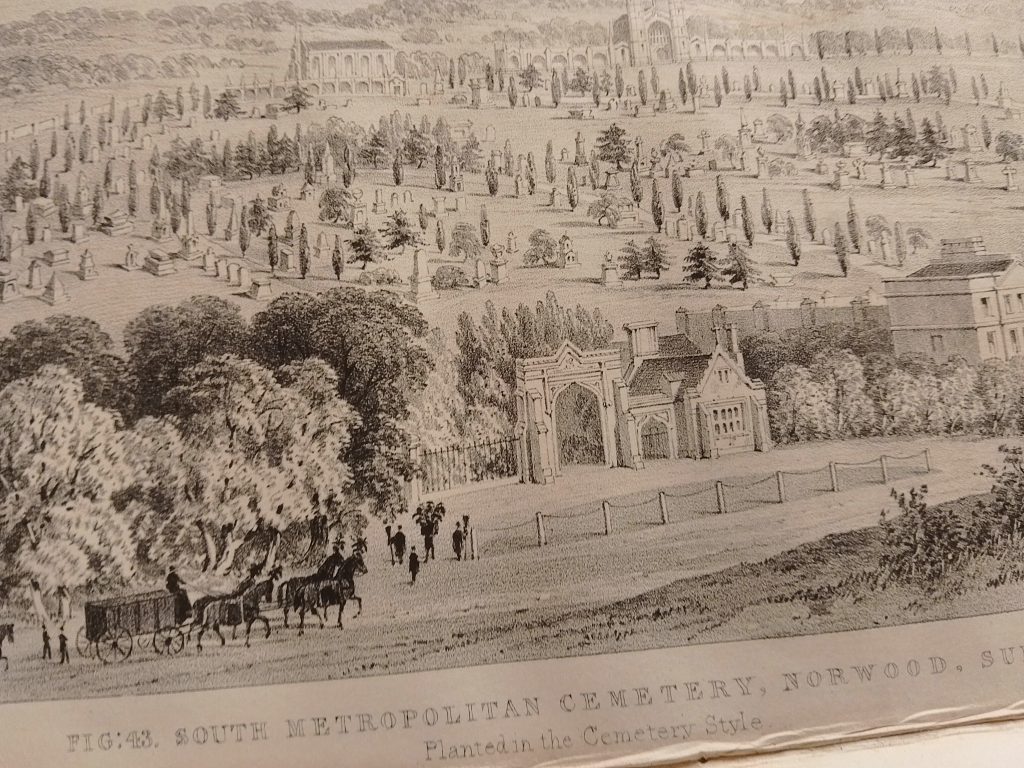
The book promotes the provision of peaceful spaces planted with trees for families to walk through and remember the lives of those who have died. Unsurprising, as Loudon was a botanist, at the end of the book is a list of plants suitable for landscaping the grounds, together with prices. When Loudon brought out the book on cemeteries, he was burdened with heavy debts accrued after he wrote an expensive illustrated book on British trees, published in 1838, which ran over budget, and he owed money to the artists. This may explain whey the cemetery book was published on poor quality paper and printed in an extremely small font. It is one of Loudon’s rarest books and was also probably printed in a small edition owing to his financial predicament.
Loudon received three commissions for planning burial grounds: Histon Road Cemetery, Cambridge 1842, Bath Abbey Cemetery, 1843-44 and a final commission at Southampton.
The LSHTM copy of Loudon’s cemetery book was acquired on 31 January 1929 in its original publisher’s light brown cloth binding with blind embossed decoration on the boards. The provenance of this copy is unknown but the signature of a former owner – probably the first – appears on the front free endpaper: ‘? G ? ? Marshall 1845’.
Today, collection building in the LSHTM Library has shifted from the design of physical structures like cemeteries to supporting people facing bereavement and grief. One woman who made a lifetime’s study of the terminally ill and promoted palliative care and provision of hospices was Elisabeth Kubler-Ross (1926-2004). Her book on On grief and grieving (Kubler-Ross & Kessler, 2005) is held in the School Library.
References
ELLIOTT, B., 2004. Loudon, John Claudius (1783-1843), landscape gardener and horticultural writer. Oxford Dictionary of National Biography 34: 475-477.
KUBLER-ROS, E. & D. KESSLER, 2005. On grief and grieving (London: Simon & Schuster) (LSHTM Library UJBM 2005).
LOUDON, J.C., 1843. On the laying out, planting, and managing of cemeteries: and on the improvement of churchyards. With sixty engravings. London: Longman, Brown, Green and Longmans. viii, 120 pp., [2] plates. (LSHTM Special Collections SI 1843); archive.org/details/b24401213 (viewed 22/9/2025).
See also : https://thegardenhistory.blog/2014/06/19/john-claudius-loudon-and-cemeteries/ (viewed 20/8/2025)
LSHTM Library Rare Books Collection Blogs is an occasional posting highlighting books that are landmarks in the understanding of tropical medicine and public health. The Rare Books Collection was initiated by Cyril Cuthbert Barnard (1894-1959), the first Librarian, from donations and purchases, assisted with grants from the Carnegie United Kingdom Trust. There are approximately 1600 historically important rare and antiquarian books in the Rare Books Collection.
Many of the LSHTM Library’s rare books were digitized as part of the UK Medical Heritage Library. This provides high-quality copyright-free downloads of over 200,000 books and pamphlets for the 19th and early 20th century. To help preserve the rare books, please consult the digital copy in the first instance.
If the book has not been digitized or if you need to consult the physical object, please request access on the Library’s Discover search service. Use the search function to find the book you would like to view. Click the title to view more information and then click ‘Request’. You can also email [email protected] with details of the item you wish to view. A librarian will get in touch to arrange a time for you to view the item.
Researchers wishing to view the physical rare books must abide by the Guidelines for using the archives and complete and sign a registration form which signifies their agreement to abide by the archive rules. More information is available on the Visiting Archives webpage.
