


By Ella Tomlin, Archives Apprentice
March 2026 marked the 115th officially recognised International Women’s Day and Women’s History Month; a month of celebrating the achievements of women and girls throughout the world, and an opportunity to reflect on their ongoing contribution and fight for an equal society. This year the theme is ‘Give to Gain’ and ‘Women Leading Change’- a testament to how the giving of opportunities, advocacy, equality and respect.
While the early 1910’s was not short on restrictions on women, it is also regarded as a time of social, political and economical change for them. As men headed off to the frontlines, opportunities for many women grew in number. Not only was there a shift in the male-dominated workforce as women filled absences, but foundations of women’s rights in the workplace became evermore stronger.
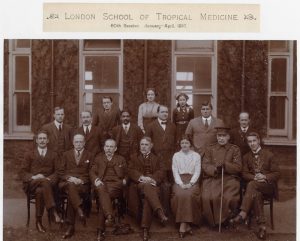
LSHTM is no exception to this change. The London School of Tropical Medicine, as it was called was governed until 1924 by the Seamen’s Hospital Society. While the first female students were enrolled in the school earlier (from the 2nd session in 1900), the laboratory staff had remained men. However, in 1915 the committee appointed institutions first female laboratory assistants known as the ‘lab girls’. While the title of ‘lab girl’ may not have been the most honourable sounding (in comparison with the male ‘Laboratory Assistant’), the position represents the beginning of an increase in opportunity and trust for women within the school.
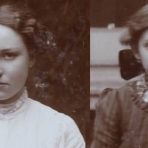
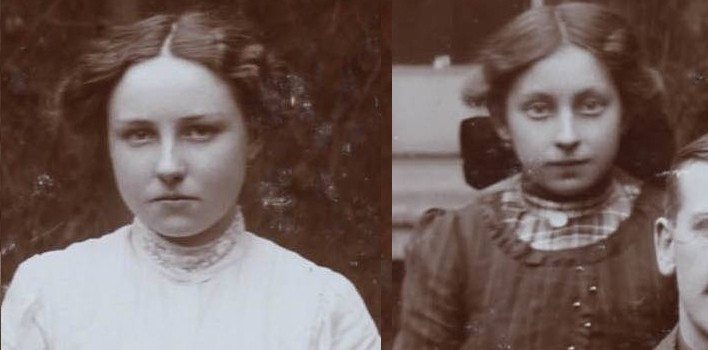
While there isn’t a huge amount of material documenting them, the first lab girl; Louise, can be seen in the group photo from the 49th Session. By the 50th session, Jane has been appointed and the pair can be seen smiling next to Robert (the lab assistant).
In the committee minutes of the 7th December 1915, we also see the pair awarded a pay raise, from 5/- per week to 8/- per week. This is a change from about £35.91 to £57.47 in 2026! Jane and Louise were not the only women to see a pay rise, the Committee minutes also noted that due to the lack of women an increase of pay of 2/ 6d (£17.96) to the laundry scrubbers and 1/ (£7.18) for maids was to be introduced. Porters and nurses were also given a wage increase during the War to accommodate for the lack of men and inflation of living costs.
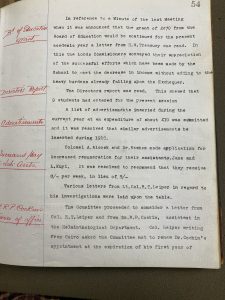
At some point between the 53rd and 54th sessions, Louise’s role progressed to Junior Lab Assistant though there is little recognising this change. Despite the obvious increase in responsibility for women during this time, there is still a lack of records of the exact work of many of them. Little is known of the lives of Louise, Jane ,and the lab girls which continued after them, outside of their roles but they are cemented in LSHTM’s history as just a small example of what girls and women can do when given the opportunity.
For further information, please contact the LSHTM Archives Service: archives@lshtm.ac.uk
l
