By Ella Tomlin, Archives Apprentice
March 21st 2026 is World Poetry Day—to celebrate, we’ve taken a look at some of the poetry and adjacent material within our collections, exploring the roles these ‘creative’ records can play in a decolonial medical archive.
“The old definition of poetry stood firm: Poetry was the perfected utterance of all fine thoughts. Science was the highest theme that Poetry could possess. If poets might sing the petty triumphs of men over men, they might also sing of the greater triumphs of man over Nature”
Quote by Sir Ronald Ross, President of the Poetry Society from his lecture ‘The Art and Craft of Authorship’ at the Lyceum Club in 1918 (Ross/132/46)
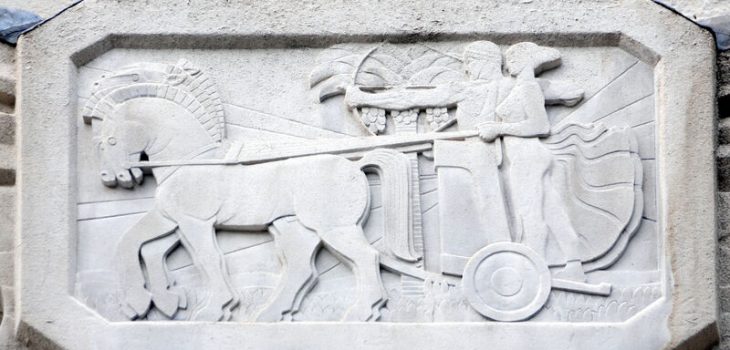
At a glance, poetry and medicine may feel contradictory, segregated as part of opposing disciplines; creative humanities pitted against objective science. This has never been any more than a widespread misconception. Romantic poet John Keats famously trained in medicine, physicians throughout history have published poetry on their research. Even Apollo (Απολλων), depicted alongside his sister Artemis on the LSHTM seal and logo, was the Greek God of both poetry and healing, plague and disease (and the father to Asclepius, the god of medicine)!
The relationship between poetry and science: Poetry in the LSHTM archive collections.
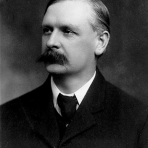
It is perhaps no surprise then, that amongst the notes and research held in the LSHTM archive collections, poetry and its impact is plentiful. The archives largest collection is that of Sir Ronald Ross, best known for highlighting mosquitos as the vector of malaria in 1897, and being the first British winner of the Nobel prize for physiology (medicine) in 1902. Beyond his contributions to tropical medicine, and to pub quizzes, Ross was also a prolific writer, capturing the emotions and topics which inspired his scientific pursuits through the medium of poetry. Most famously, one penned just moments after his discovery on August 20th, 1897:
This day relenting God
Hath placed within my hand
A wondrous thing; and God
Be praised. At His command,
Seeking His secret deeds
With tears and toiling breath,
I find thy cunning seeds,
O million-murdering Death.
I know this little thing
A myriad men will save.
O Death, where is thy sting?
Thy victory, O Grave?
Ross can be viewed as somewhat of a patron of the relationship between science and poetry, giving several lectures on the topic in the late 1910’s and early 1920’s.
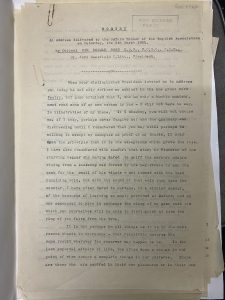
Within our Ross collection, we hold press cuttings, letters, lecture notes and extracts of poetry emphasising Ross’s view of poetry and creativity as an outlet and inspirer for training physicians and researchers. And he is far from the only example.
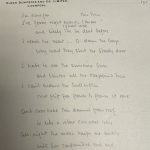
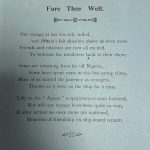
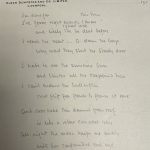
“You can’t hide yourself in a poem”: The place for poetry in an archive
It has been said that it is poems, or creative writing, in which the true self is revealed. Certainly for many, there is no separating the individual ideals from the writing on the page. Rudyard Kipling is a prominent example of the way personal opinions can infiltrate poetry and he has long been critically unpopular as a result.
As seen with the Keats-Shelley Association of America, closely reading poetry encourages a greater discussion of their personal flaws, misunderstandings and judgements, and can contribute to the decolonising of an archive collection. (https://www.k-saa.org/blog/keats-200-event-poetry-versus-colonialism-at-keats-house-with-laila-sumpton?rq=colonial)
Poetry then, presents an exception to the ‘medical objectivity’ which can be awarded to the research-based materials within the archive, and can be seen to present a fuller picture (as much as is possible) of individuals ‘commemorated’ by our collections. The LSHTM archive is always working to confront the colonial history of our collections. By sharing the poetry of Macfie, Ross and others within our collection who were a product of colonial Britain, we share a piece of their soul–separate from their medical study—with the world, and welcome critical response.
Poetry and the opportunity to respond
Just as poetry can be a creative outlet for the medical student, and a brutally honest reflection of flawed individuals, poetry provides a space for individuals to respond to archived material and engage with critical debates.
In 2021, as part of the Wellcome Trust-sponsored Black Health and the Humanities project at the University of Bristol, Dr Lioba Hirsch (who worked on the LSHTM and Colonialism report) showed a film ‘Roads to Africa’ from our collection to PhD and early career researchers and asked them to creatively engage with it. The results, including a poem by Parise Carmichael-Murphy are featured in this blog post.
Five years later, the poem forms an important part of our use of the ‘Roads to Africa’ film, framing our understanding of it. The poem highlights how collections can be reframed through poetry , and how these creative responses themselves become a part of archival history. We continue to welcome creative responses to our collections.
