

James Lind is one of the names of 26 men and women, pioneers of public health and tropical medicine, on the frieze of the London School of Hygiene & Tropical Medicine (LSHTM) building in Keppel Street.

Lind’s name on the Frieze around the building at Keppel Street. More information here: https://www.lshtm.ac.uk/aboutus/introducing/history/behind-frieze
Lind was born in Edinburgh in 1716 and trained as a physician. He worked as a royal naval surgeon from 1738-1748, the experience of which led him to develop an interest in seamen’s welfare and the nature and treatment of scurvy that were to be the subjects of his life’s work. He operated a medical practice in Edinburgh from 1748 until 1758. He was chief physician to the Royal Navy’s Haslar Hospital in Gosport, Hampshire from 1758-1783. He died at Gosport in 1794.
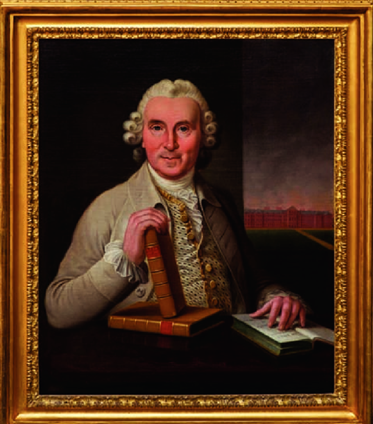
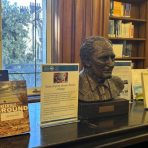
Portrait of Lind: Sir George Chalmers’ portrait of James Lind, painted in 1783.
We now know that scurvy – a common ailment of sailors in the 18th and 19th centuries, characterised by fatigue, joint pain, and gum disease – is caused by poor diet and prolonged vitamin C deficiency. In Lind’s investigations into the cause and treatment of scurvy, he conducted experiments with suffering seamen: half of the men were given fresh oranges and lemons, after which they recovered; the other group did not. In 1753 Lind published A treatise of the scurvy, he set out the results of his experiments (pp. 191-193). But Lind’s evidence was buried in the 470-page text, and this, his sometimes muddled writing and reticence meant his pioneering work on the cure for scurvy was overlooked by the Admiralty and he made no immediate impact on naval medicine. It was Captain James Cook – who carried oranges and lemons on his three circumnavigations (1768-1780), and kept his crew free of scurvy – who was given the credit. And it was not until 1795 that the Admiralty started issuing seamen with a ration of oranges and lemons.
Lind’s second book was An essay on the most effectual means of preserving the health of seamen in the Royal Navy, published in 1757, in which he argued for better hygiene on ships, more humane treatment of the men and guidelines for combating diseases on long voyages. A new work, Lind’s third, followed in 1768, An Essay on diseases incidental to Europeans in hot climates, in which he reviewed dangerous hazards with recommendations and procedures for avoiding them.
References
BARTHOLOMEW, M., 2004. Lind, James (1716-1794) naval surgeon and physician. Oxford Dictionary of National Biography 33: 810-813 port.
CARPENTER, K.J., 1986. The history of scurvy and Vitamin C. Cambridge : Cambridge University Press (LSHTM Library GR.D 1986).
CUPPAGE, F.E., 1994. James Cook and the conquest of scurvy. Westport, Connecticut : Greenwood Press (Contributions in medical studies 40) (LSHTM Library GR.D. 1994)
LIND, James, 1753. A treatise of the scurvy. In three parts. Containing an inquiry into the nature, causes, and cure, of that disease. Together with a critical and chronological view of what has been published on that subject. Edinburgh: Printed by Sands, Murray, and Cochran for A. Millar … London. (LSHTM Library Historical Collection GR 1753).
LIND, J., 1757. An essay on the most effectual means of preserving the health of seamen, in the Royal Navy. London: Printed for A. Millar, A. Kincaid and A. Donaldson. (Not held by LSHTM Library).
LIND, James, 1768. An essay on diseases incidental to Europeans in hot climates. With the method of preventing their fatal consequences. … To which is added, an appendix concerning intermittent fevers. To the whole is annexed, a simple and easy way to render salt water fresh, and to prevent a scarcity of provisions in long voyages at sea. London: Printed for T. Becket and P.A. De Hondt (LSHTM Library Historical Collection UB 1768); 2nd ed. 1771 (LSHTM Library Historical Collection UB 1771); 3rd ed. 1777 (LSHTM Library Historical Collection UB 1777).
LIND, James, 1953. Lind’s treatise on scurvy: a bicentenary volume containing a reprint of the first edition of ‘A Treatise of the Scurvy’ by James Lind, M.D. with additional notes. By C.P. Stewart & D Guthrie (editors). Edinburgh: University Press. (LSHTM Library GR.D 1953).
LSHTM Library Rare Books Collection Blogs is an occasional posting highlighting books that are landmarks in the understanding of tropical medicine and public health. The Rare Books Collection was initiated by Cyril Cuthbert Barnard (1894-1959), the first Librarian, from donations and purchases, assisted with grants from the Carnegie United Kingdom Trust. There are approximately 1600 historically important rare and antiquarian books in the Rare Books Collection.
Many of the LSHTM Library’s rare books were digitized as part of the UK Medical Heritage Library. This provides high-quality copyright-free downloads of over 200,000 books and pamphlets for the 19th and early 20th century. To help preserve the rare books, please consult the digital copy in the first instance.
If the book has not been digitized or if you need to consult the physical object, please request access on the Library’s Discover search service. Use the search function to find the book you would like to view. Click the title to view more information and then click ‘Request’. You can also email library @lshtm.ac.uk with details of the item you wish to view. A librarian will get in touch to arrange a time for you to view the item.
Researchers wishing to view the physical rare books must abide by the Guidelines for using the archives and complete and sign a registration form which signifies their agreement to abide by the archive rules. More information is available on the Visiting the Archives webpage.
