
Skip to content
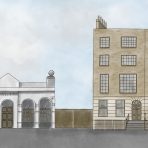
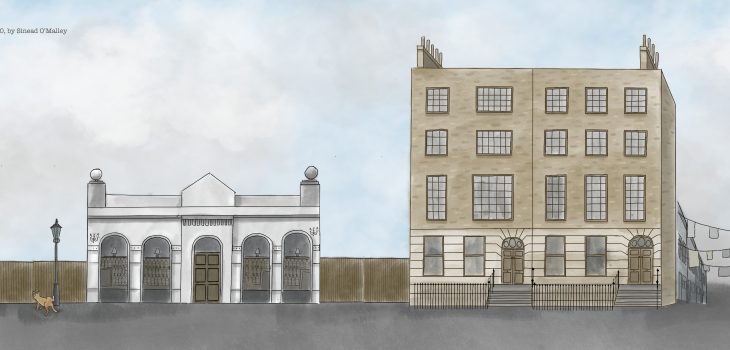
Watercolour style painting showing a line of buildings. Between the buildings there is a small tree and brown fence, a washing line, an orange cat and a lamp-post.

2026: 100 Year Anniversary of the Laying of the Foundation Stone

This exhibition explores the 100 year anniversary of the laying of the foundation stone for the  Keppel Street building; from the purchase of the new land, the foundation stone ceremony to the building we know and love.

The Journey to Keppel Street

Explore behind the scenes of the move, design and construction of the Keppel Street building.

Albert Dock Building.

The original School was established as part of the Seamen’s Hospital Society which has its origins in the hospital ships which docked on the Thames at Greenwich. The Hospital and School were based in the Albert Docks as this is where the largest number of ships docked in Great Britain and it gave students the chance to see tropical diseases in their acute stages.

(LSHTM buildings/04/04/10)
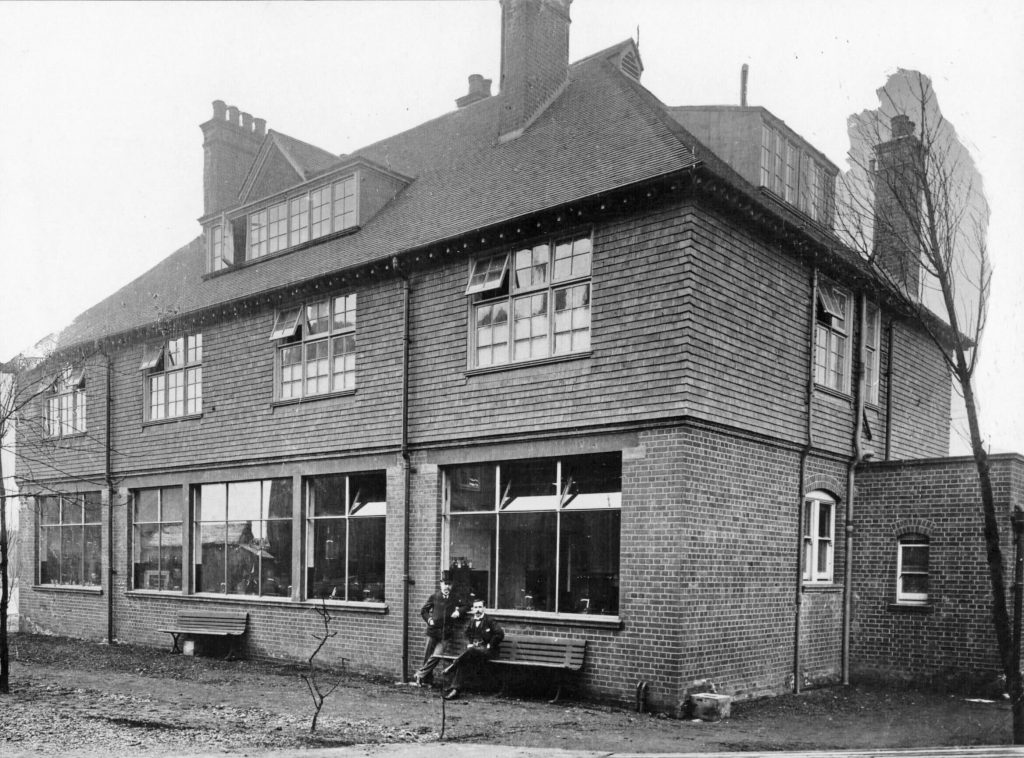
Brick building with large windows.
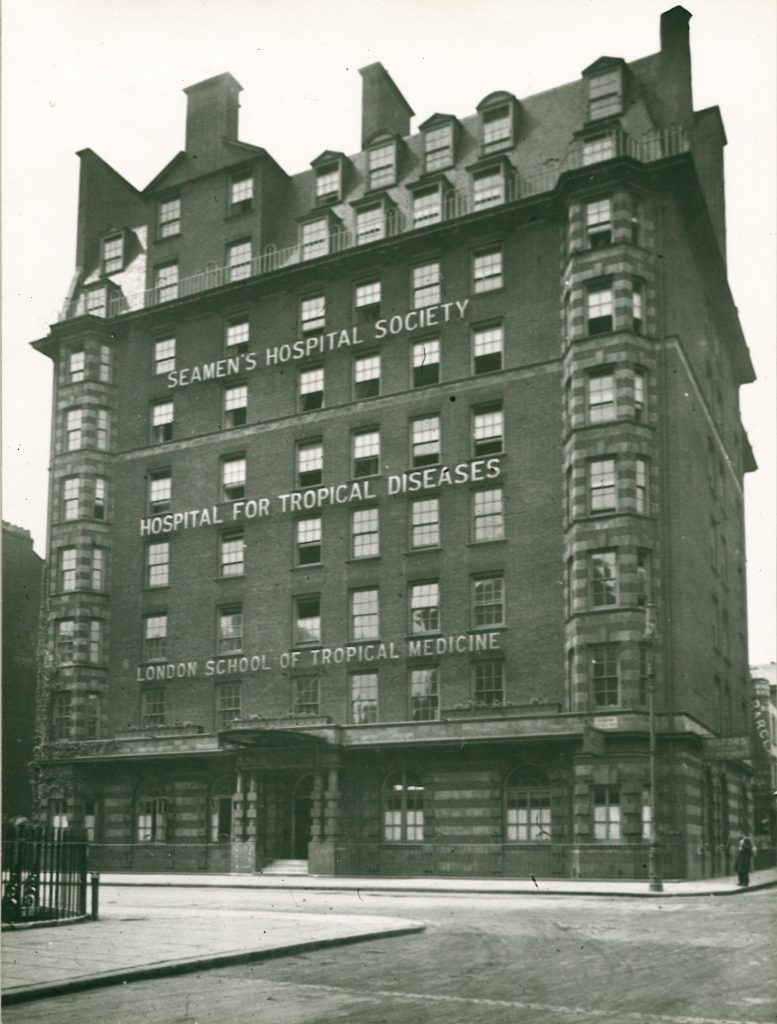
Large, several story brick building with sign reading 'Seamen's Hospital Society Hospital for Tropical Diseases, London School of Tropical Medicine.

The previous building, Endsleigh Gardens c.1920;

In 1920, the London School of Tropical Medicine (as it was known at the time), with the Hospital for Tropical Diseases moved to Endsleigh Gardens taking over a former hotel which had been used as a hospital for officers during the First World War. The building now acts as the UCL Student Union on Gordon Square.

(LSHTM buildings/04/06/07)

Keppel Street site before LSHTM.

Keppel Street was part of the Duke of Bedford’s Bloomsbury estate and previously contained 40 Georgian houses (when it originally ran to Russell Square) and another 42 in Keppel Mews North (now Malet Street). A well-to-do area in Victorian times, Keppel Street housed several distinguished residents, including the painter John Constable, the novelist Anthony Trollope, the Irish nationalist politician Charles Stewart Parnell and the American illusionist Harry Houdini. As well as residential properties, there was a wine shop and a chapel on the site but these had all been demolished by 1911. (https://grokipedia.com/page/keppel_street)
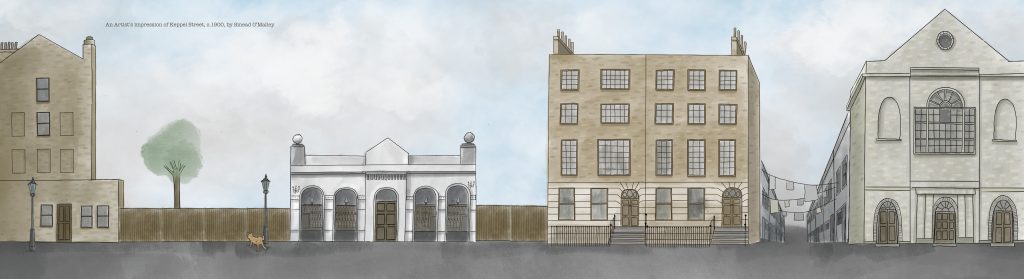
Watercolour style painting showing a line of buildings. Between the buildings there is a small tree and brown fence, a washing line, an orange cat and a lamp-post.
Artistic impression of Keppel Street c.1900 by Sinead O’Malley

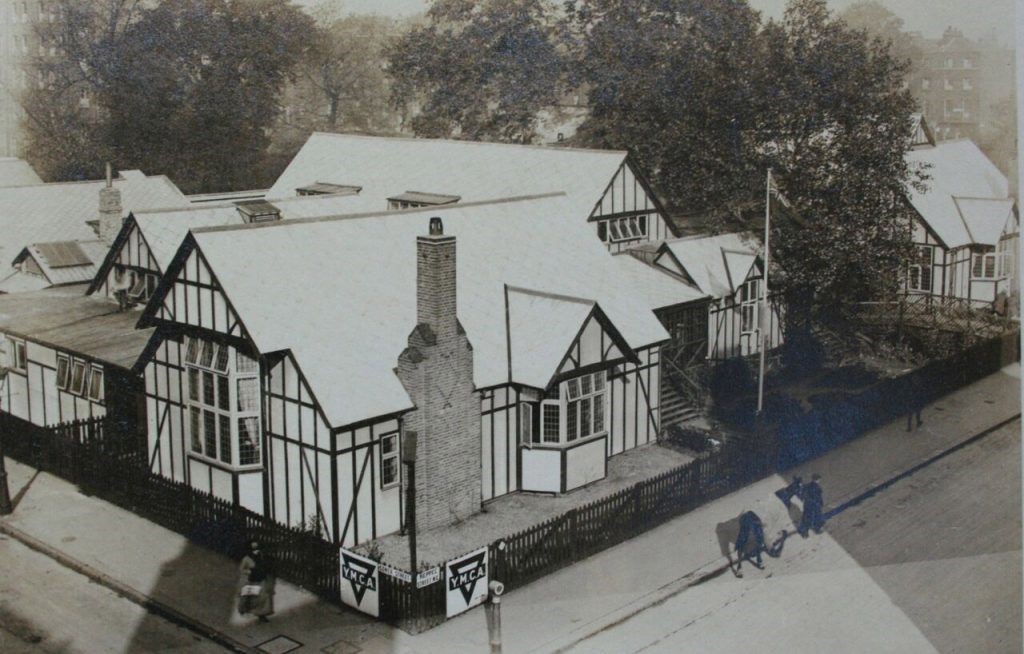
Shakespeare’s Hut, 1916.

The National Theatre Committee purchased the Keppel Street site in 1913. It intended to build a Shakespeare Memorial Theatre in readiness for the tercentenary of the playwright’s death in 1916. These plans were shelved at the outbreak of the First World War.

In 1916 a YMCA hut called the Shakespeare Hut was constructed as a ‘home away from home’ for Anzac soldiers to rest, recover and be entertained. In 1923 the Rockefeller Foundation bought the site for £52,000 (which would be approximately £2.6 million today).

Single story building with a white roof and walls, and black paneling surrounded by a short fence. A logo for YMCA is visible in the front of the image.
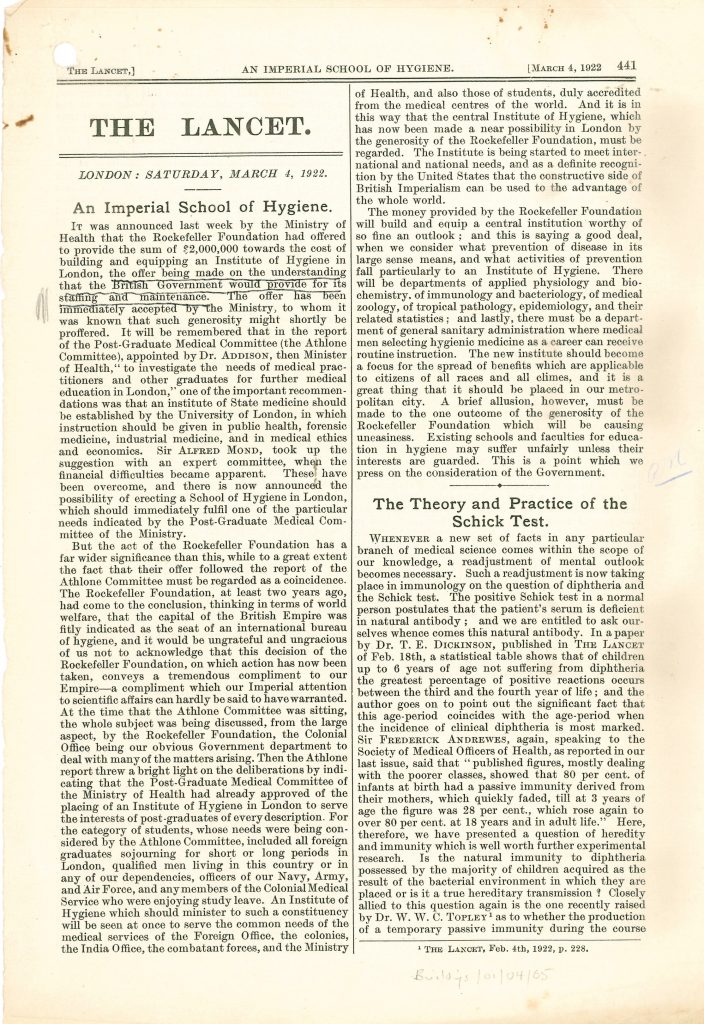
The Lancet, March 4th 1922: An Imperial School of Hygiene.

The Rockefeller Foundation.

Lancet article article announcing the Rockefeller Foundation’s gift of $2 million (equivalent of around $40 million today) towards the building and equipping of Keppel Street. 

Acknowledging LSHTM’s colonial ties also includes evaluating the donors and contributors.

In recent years, The Rockefeller launched an internal investigation to uncover details about its involvement in the eugenics movement. More information can be found on this here.


Architects design of the building.

A competition was held to design the new Keppel Street building, five sets of architects (all experienced in laboratory design and construction) entered. The winning design was by Morley Horder and Verner Rees.
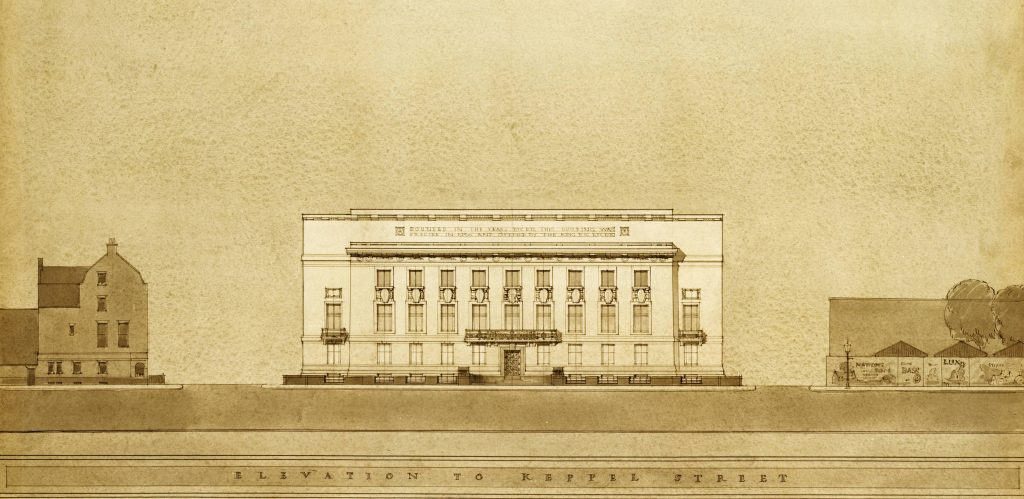
Sketch of rectangular building from the front angle. The sketch shows 3 levels of windows with a flat roof above.
Verner O Rees drawing of an elevation to Keppel Street prior to construction, c.1920s. (LSHTM buildings/01/09/09)
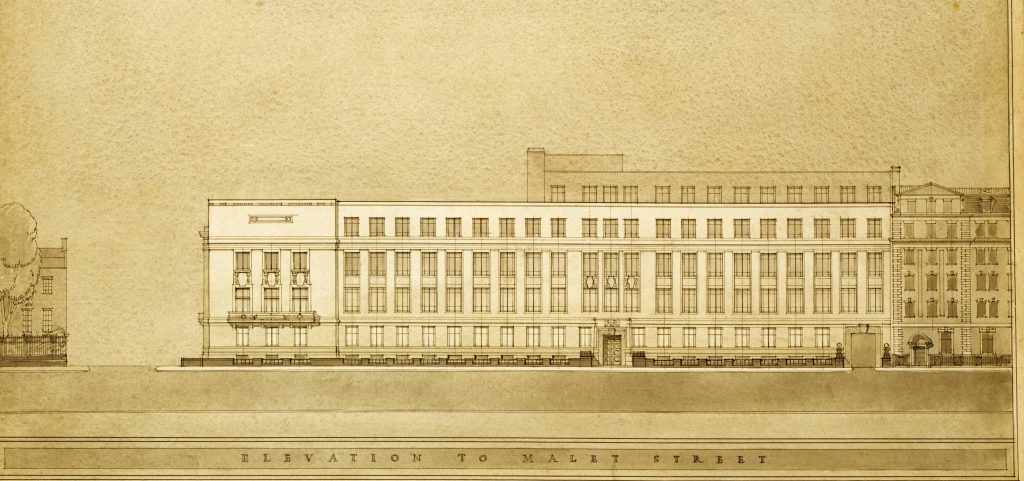
Sketch of rectangular building from the side angle. The sketch shows 4 levels of windows with a flat roof above. There are some further buildings sketched to appear as in the background
Verner O Rees drawing of an elevation to Malet Street prior to construction, c.1920s. (LSHTM buildings/01/09/09)
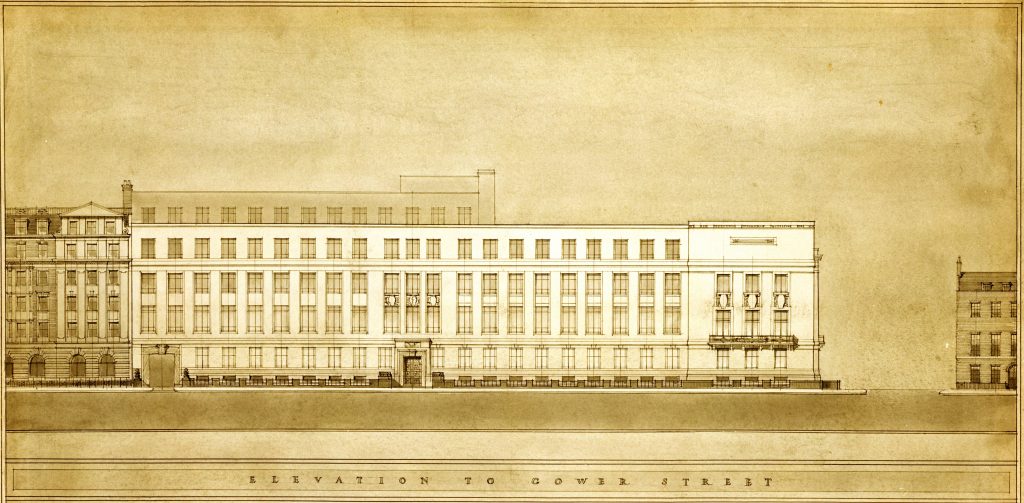
Sketch of rectangular building from the side angle. The sketch shows 4 levels of windows with a flat roof above. There are some further buildings sketched to appear as in the background
Verner O Rees drawing of an elevation to Gower Street prior to construction, c.1920. (LSHTM buildings/01/09/09)
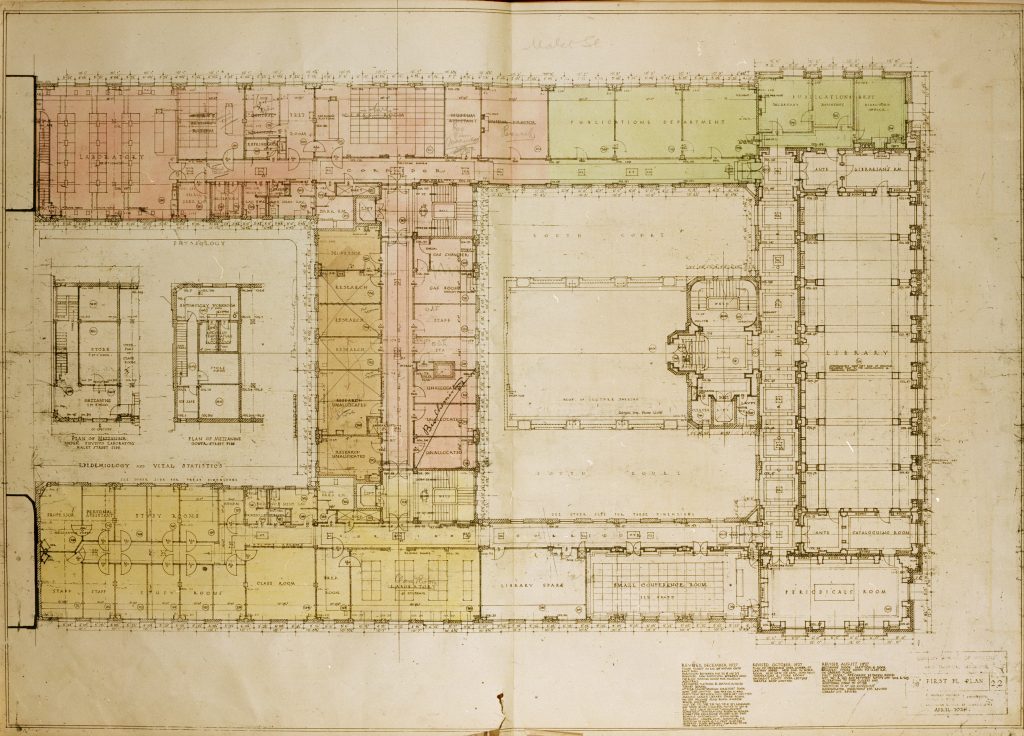
Floor plan in the shape of a capital A with 2 courtyards in the centre.
Original architect floorplan of first floor of Keppel Street building, c.1920s. (LSHTM buildings/01/09/05)
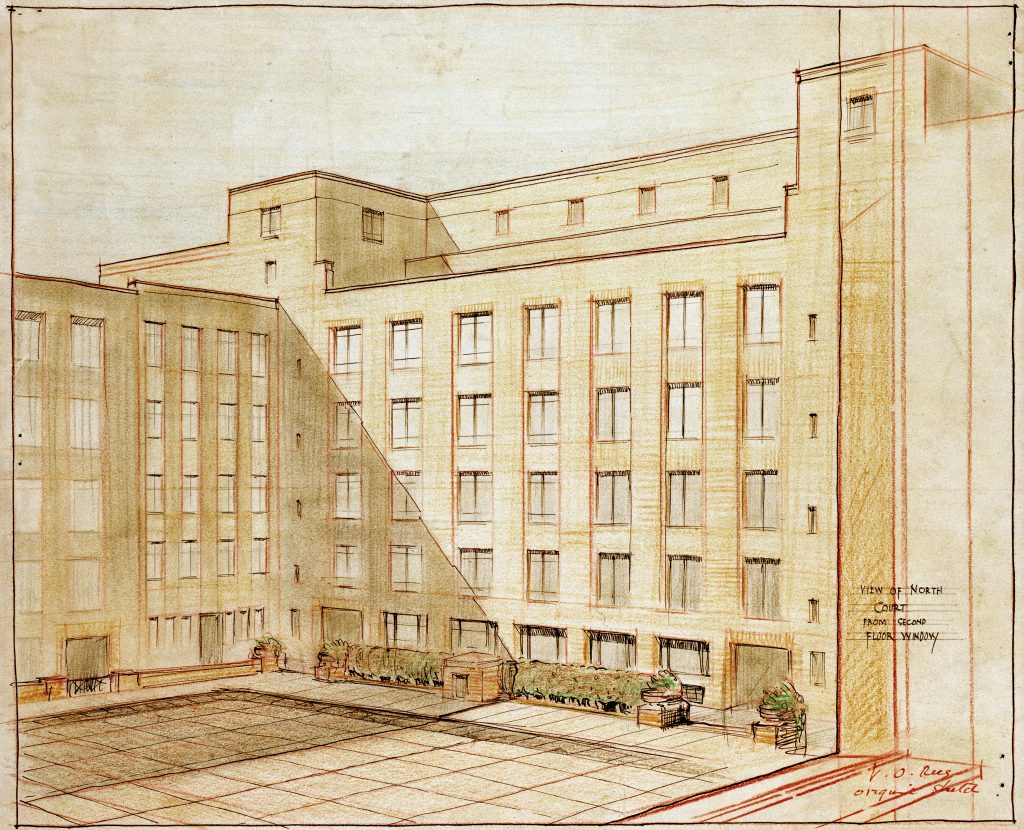
Sketch of 2 corners of a building meeting, with a small courtyard in the foreground
Architect sketch of “View of North Court from Second Floor Window”, c.1920s (LSHTM buildings/?)
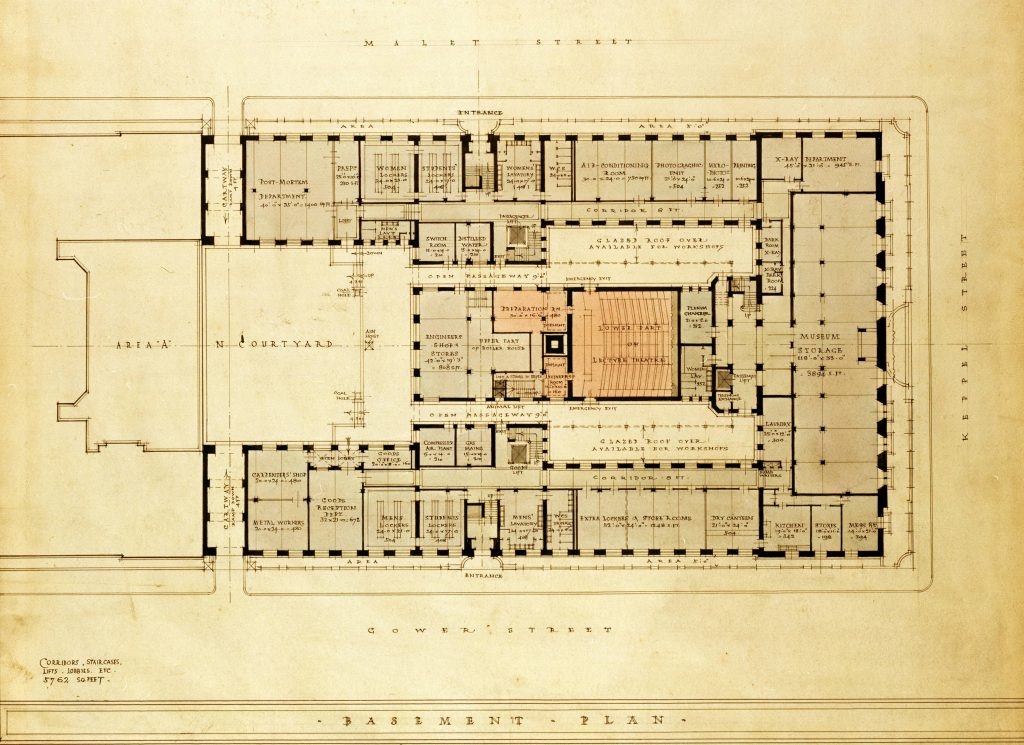
Floor plan in the shape of a capital A.
Original architect floorplan of proposed basement (now lower ground floor) of Keppel Street building, c.1920s (LSHTM buildings/01/09/07)
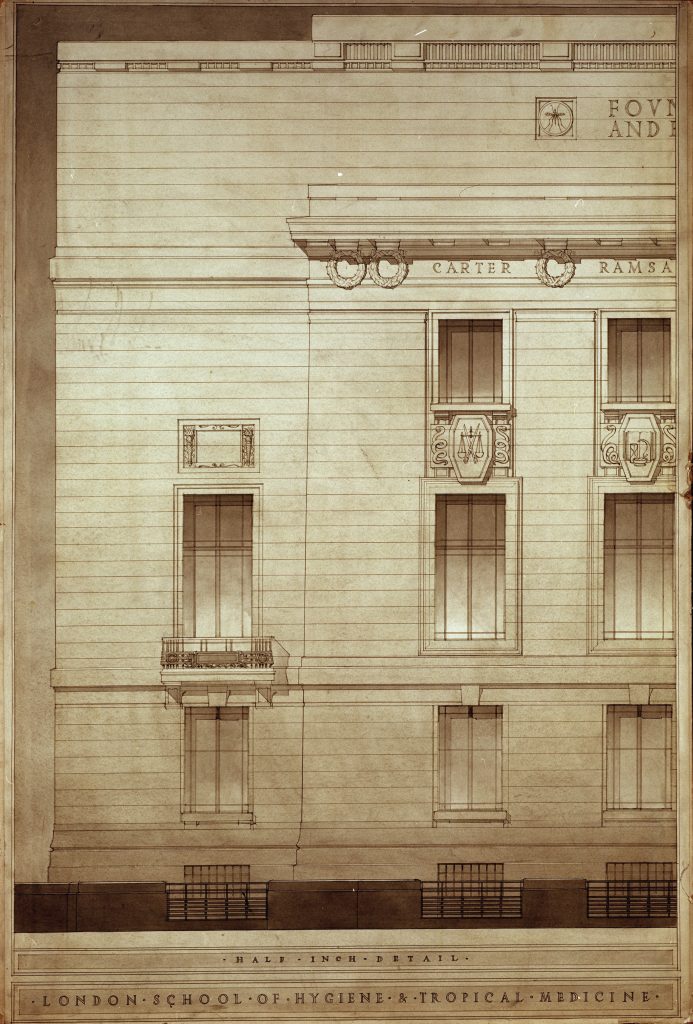
Close up sketch of a rectangular building showing 3 levels of windows with details of a set of scales below the top set of windows. The roof is flat and features Latin lettering below reading 'CARTER RAMSA-'. caption on the sketch reads 'half inch detail, London School of Hygiene and Tropical Medicine'
Exterior of the building (detail of elevation), c.1920s (LSHTM buildings/01/09/08)

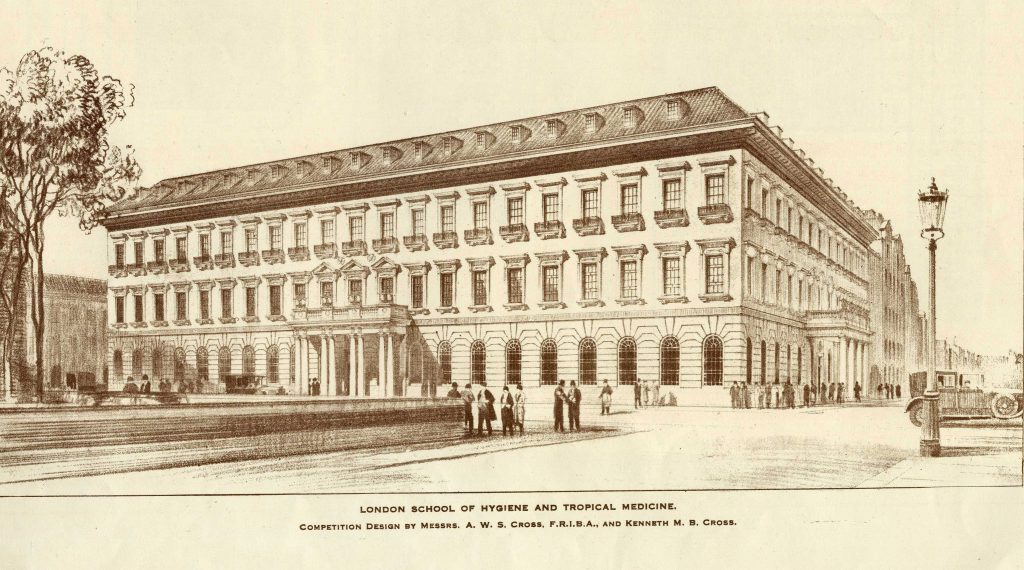
Sketch of large rectangular building.

Unsuccessful entry, 1926.

This is one of the unsuccessful entries in the competition to choose an architect for the school. This design, by Messrs A.W.S. Cross and Kenneth M.B. Cross is more ornate than the winning design.(LSHTM Buildings/01/04/03). 


The 1926 General Workers Strike. 

According to a report in the British Medical Journal of 28th May 1927, construction of the LSHTM Keppel Street building was delayed as a result of the General Strike. The strike lasted May 4th-12th 1926,  an unsuccessful attempt to force the British government to act to prevent wage-reductions and worsening conditions for 1.2 million locked-out coal miners. It was a sympathy strike, with many of those who were not miners and not directly affected striking to support the locked-out miners.
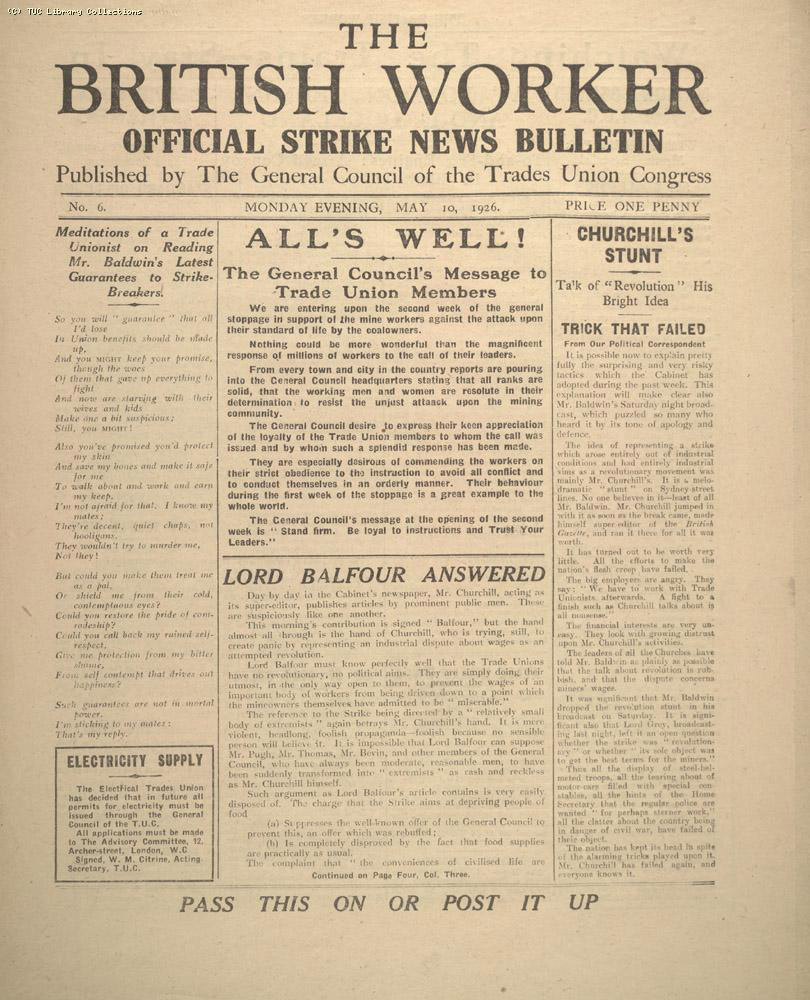
Newspaper page titled 'The British Worker Official Strike News Bulletin: All's Well'
Newspaper bulletin on the General Strike (Camden Local History Centre)
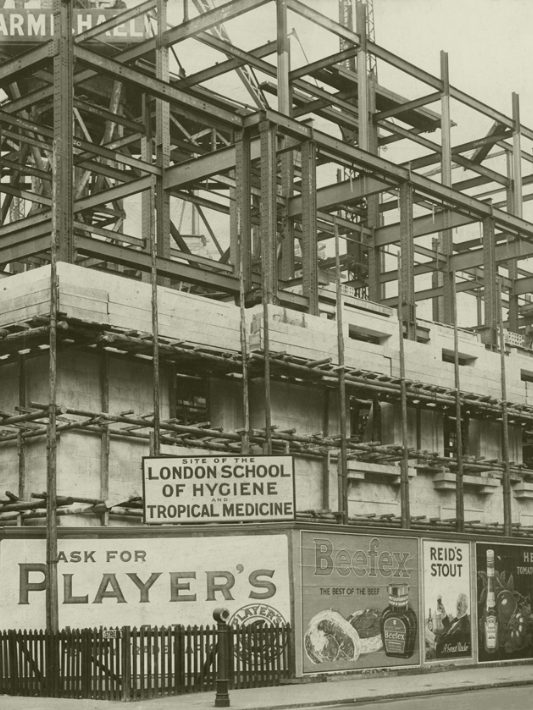
Scaffolding around a building with sign reading 'London School of Hygiene and Tropical Medicine'
Image of the construction site of the school on Keppel Street, 1927 (LSHTM buildings/04/04/02)
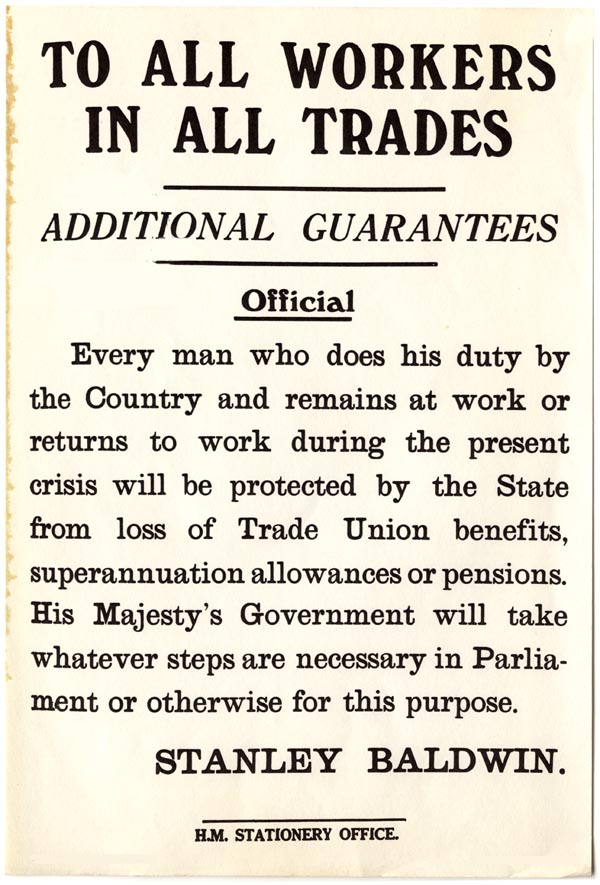
Off-white poster with black text reading 'To all workers in all trades, additional guarantees. Official. Every man who does his duty by the Country and remains at work or returns to work during the present crisis will be protected by the State from loss of Trade Union benefits, superannuation allowances or pensions. His Majesty's Government will take whatever steps are necassary in Parliament or otherwise for this purpose. Stanley Baldwin.'
General Strike Poster (Camden Local History Centre)
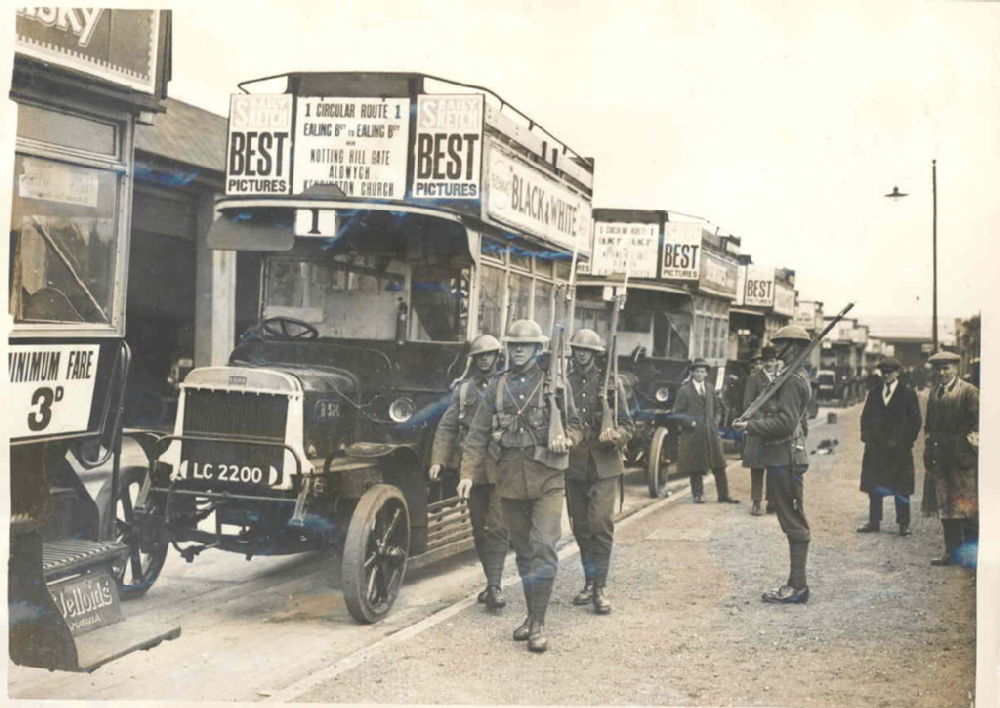
Armed soldiers walking beside a line of black buses.
Image of the general strike, 1926 (Camden Local History Centre)

Building Contracts, December 1925. 
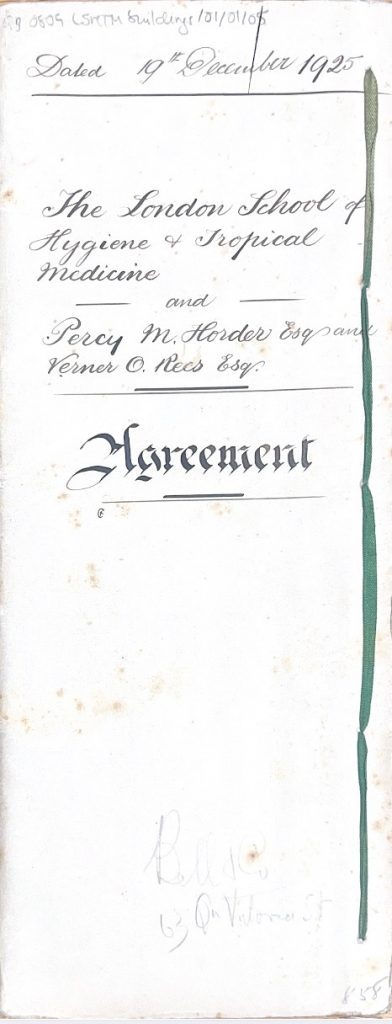
Front page of contract with handwritten text; 'Dated 19th December 1925, The London School of Hygiene and Tropical Medicine and Percy M. Horder Esq and Verner O. Rees Esq, Agreement'
Contractual Agreement with Percy M. Horder and Verner O. Rees as architects of LSHTM Keppel Street (LSHTM buildings/01/01/05)
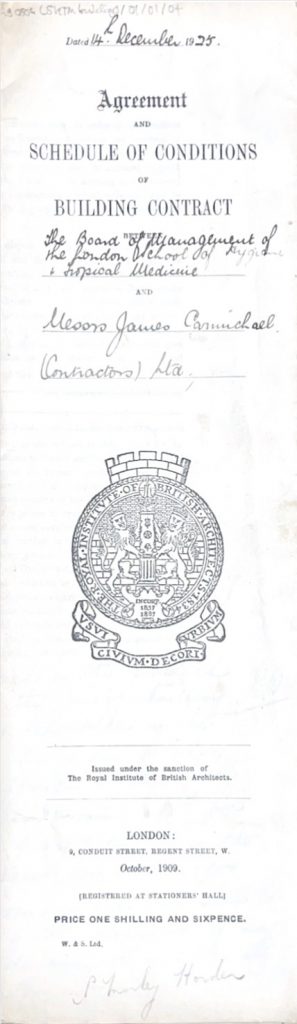
Front page of contract with handwritten text; 'Dated 14th December 1925, Agreement and Schedule of Conditions of Building Contract, The Board of Management of The London School of Hygiene and Tropical Medicine and Messrs James Carmichael (*Contractors) Ltd.'' with a crest for the Royal Intitute of British Architects'
Agreement with the buildings contractors Messrs James Carmichael Ltd. (LSHTM buildings/01/01/04)

Ceremony of the Laying of the Foundation Stone

Explore the event for the Ceremony of the Laying of the Foundation Stone, the guests, schedule and experience. 
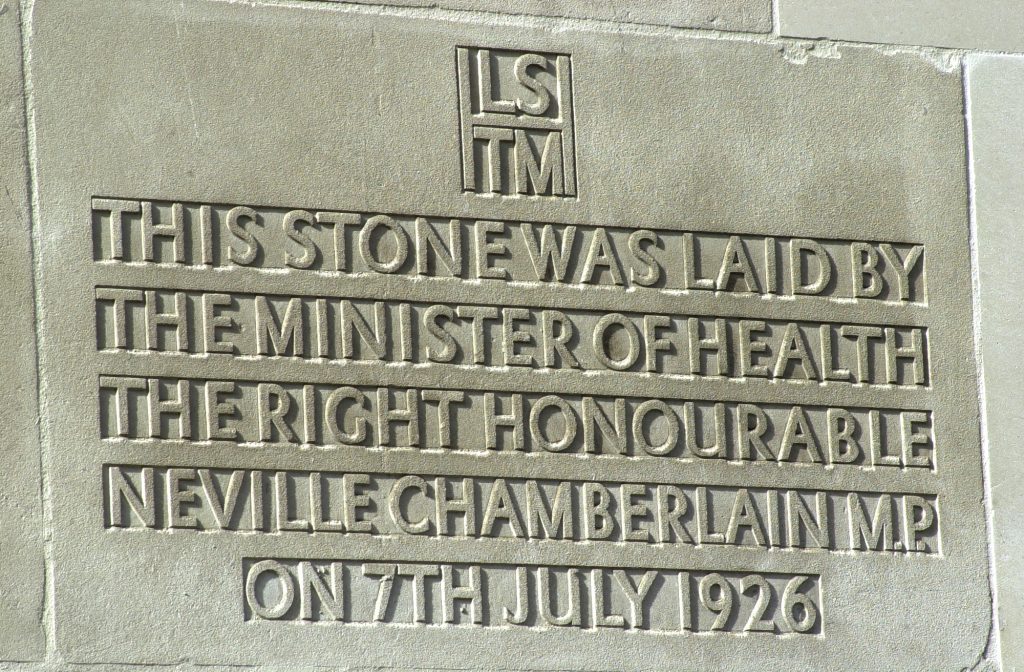
Rectangular stone with engraving which reads 'This stone was laid by The Minister of Health The right Honourable Neville Chamberlain M.P. on the 7th July 1926.'
The Foundation Stone. The foundation stone can be seen on the front of the Keppel Street building, to the right of the entrance. (LSHTM buildings/04/05/05)
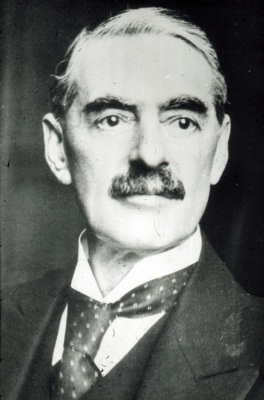
Neville Chamberlain, a white man with short white hair, and a bushy mustache and eyebrows. He is wearing a white shirt with a tie and blazer and is looking sternly to the side of the camera.
Neville Chamberlain. (Chave/04/13/09)

‘We who are assembled here to-day and are looking forward into the future must indeed be lacking in imagination if we do not feel convinced that this great concentrated effort, this prolonged and sustained education of trained minds, and the following of the great maxim that prevention is better than cure, will here play a beneficent and noble part in the happiness and the health of mankind’ – Neville Chamberlain, Speech at the Laying of the Foundation Stone Ceremony

Neville Chamberlain was the Minister of Health 1923-1929 (and again briefly in 1931) and was invited to lay the foundation stone for the Keppel Street building. He went on to be Prime Minister in 1937.  

Neville’s father, Sir Joseph Chamberlain was Secretary of State for the Colonies, it was due to partial funding from the Colonial Office that the school was able to be established in 1899. Colonies were also instructed by the Colonial Office to contribute money for the establishment of the School and pay regular financial contributions for the first 30 or so years of the School’s existence. In short, the foundation and maintenance of the London School of Tropical Medicine, as it was then known, were made possible through the forced labour and financial exploitation of colonised subjects. 

There is more information on the School’s colonial ties, and the continued work of the archives service to address the historic and ongoing consequences of this here.
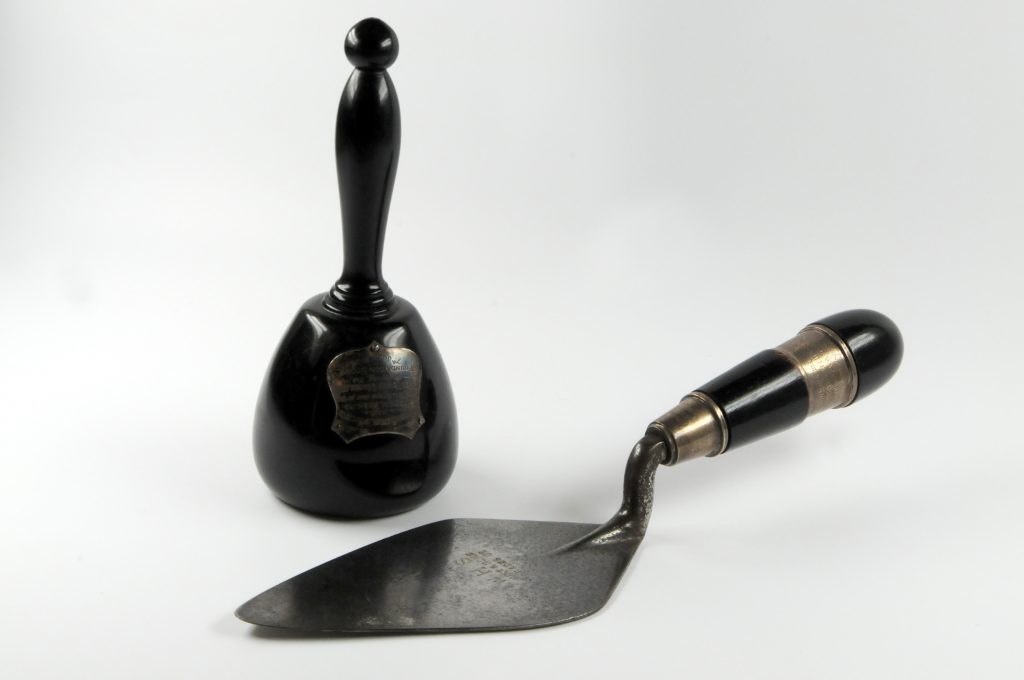
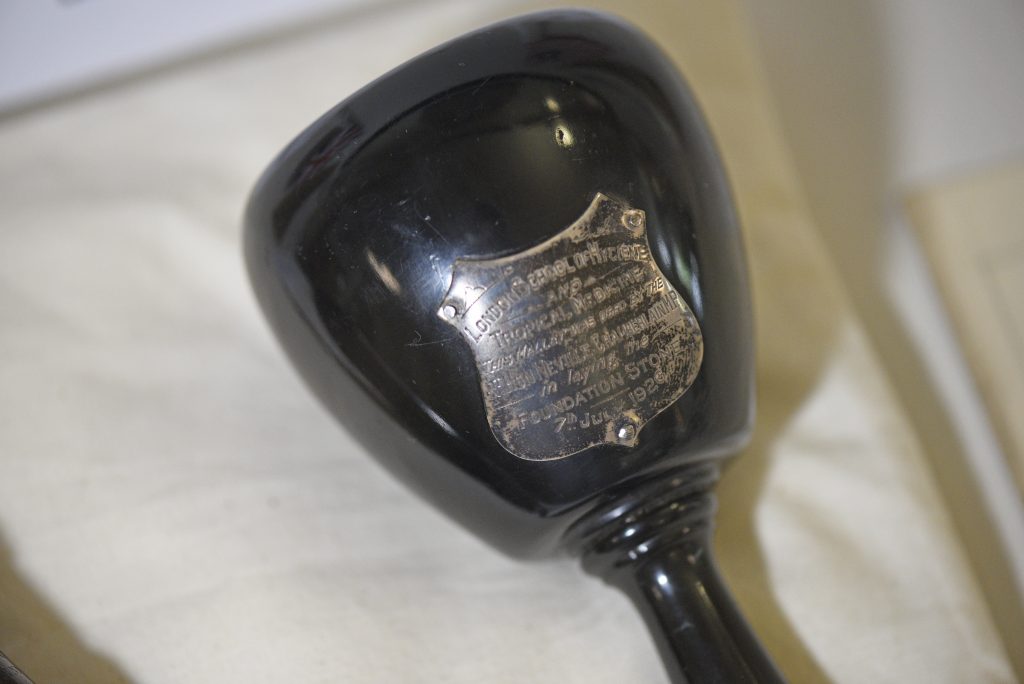
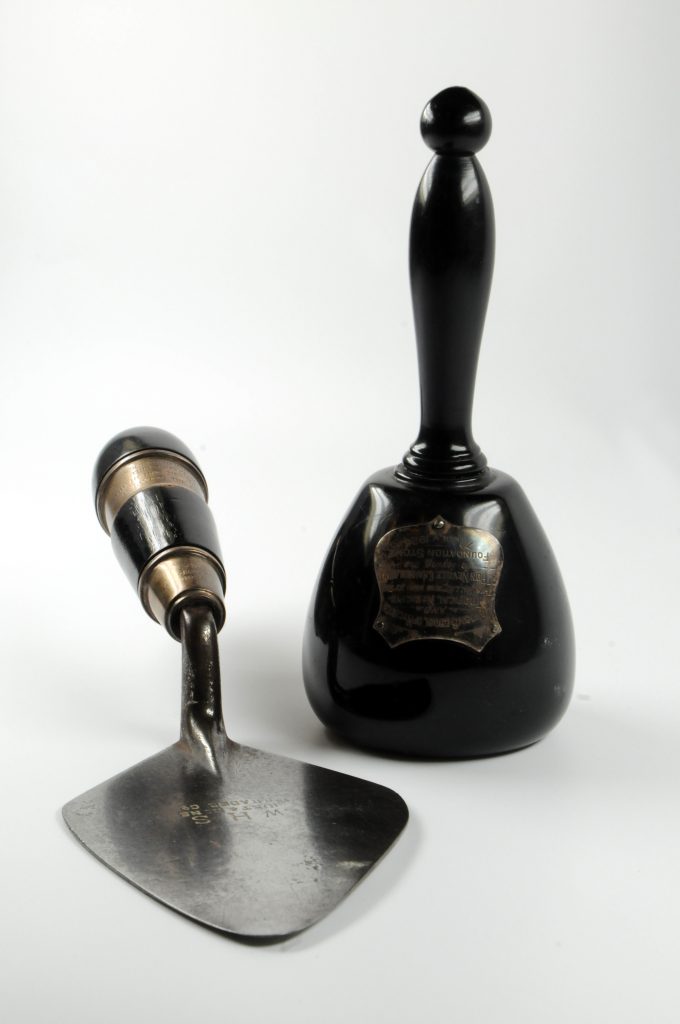
Black mallet with small silver plaque on the front. In front is a silver trowel with a black and gold handle.
Ceremonial Trowel and Mallet, 1926. Trowel and Mallet used by Right Honourable Neville Chamberlain, Minister of Health in the laying of the foundation stone. These were commissioned especially for the event and have remained a part of the archives collection. Photographed by Anne Koerber. (LSHTM buildings/04/05/06)
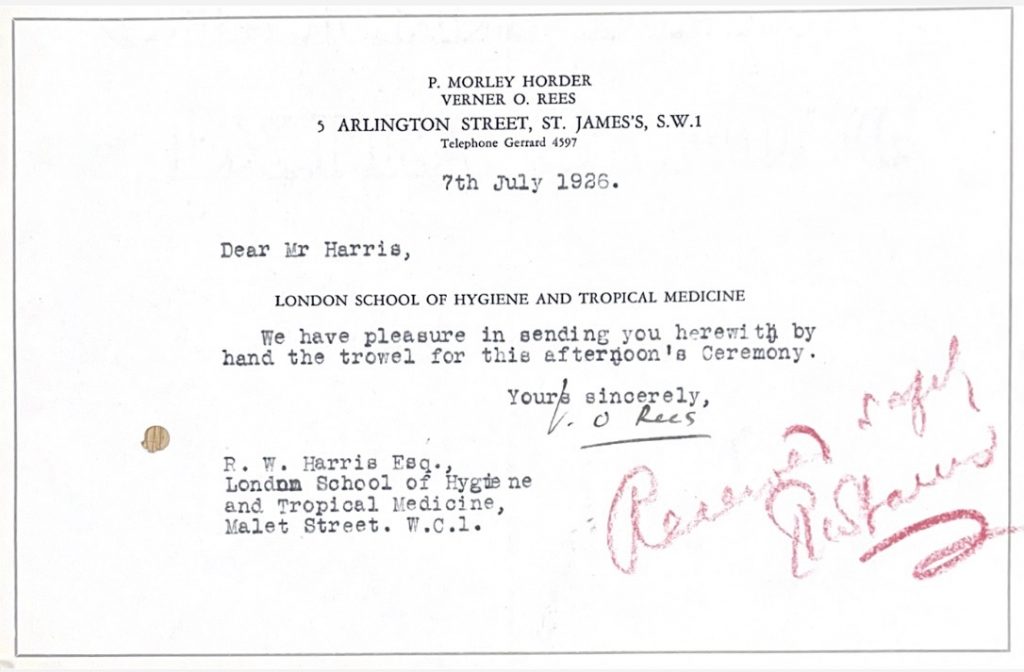
Typed note on white paper reading 'P. Morley Horder, Verner O. Rees, 5 Arlington Street, St. James, S.W.1. 7th July 1926. Dear Mr harris, London School of Hygiene and Tropical Medicine. We have pleasure in sending you herewith by hand the trowel for this afternoon's Ceremony. Your sincerely, V.O Rees' There is an illegible red note in the corner.
Accompanying note for the trowel and mallet. (LSHTM buildings/01/05/01)

The ‘Ceremony of the Laying of the Foundation Stone’ was quite the affair boasting famous guests, grand speeches, music and food to surround the placing of the stone.
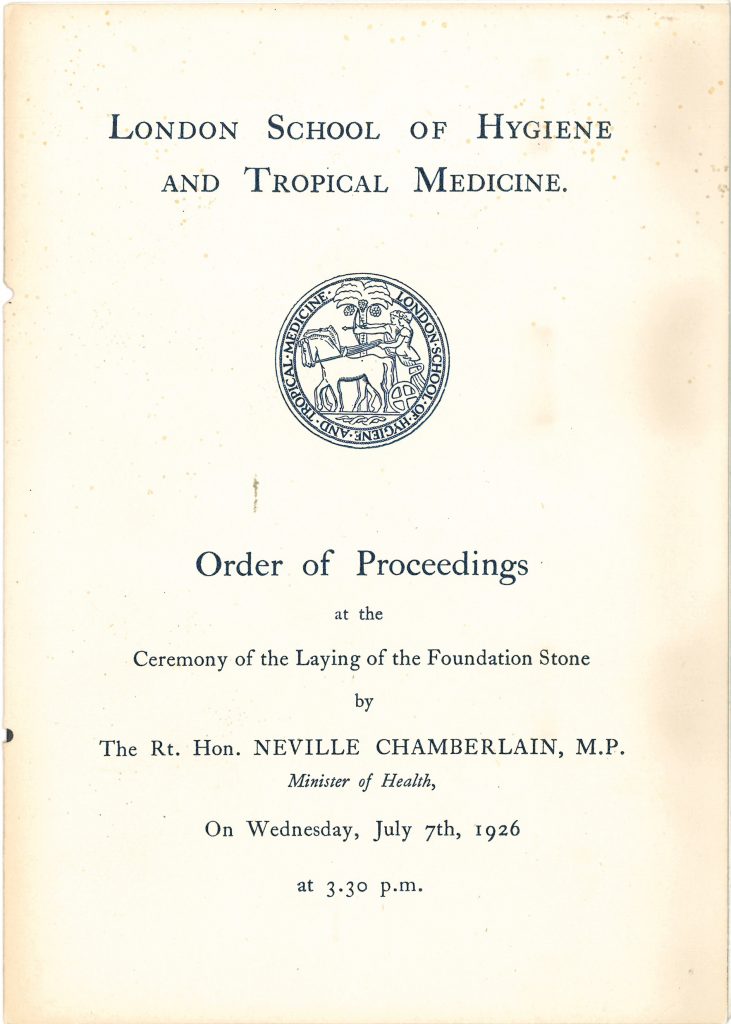
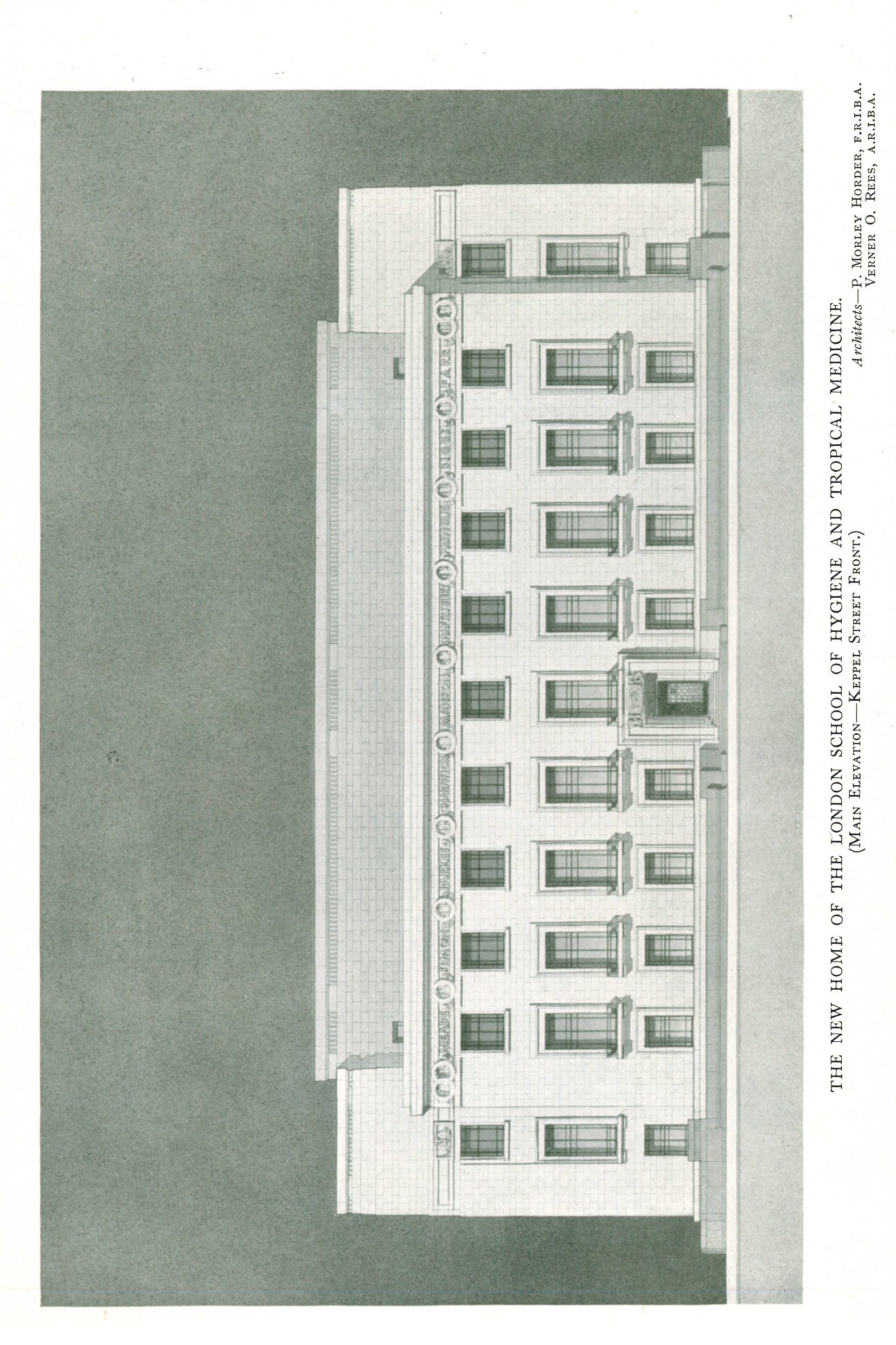
Order of Proceedings, 1926.

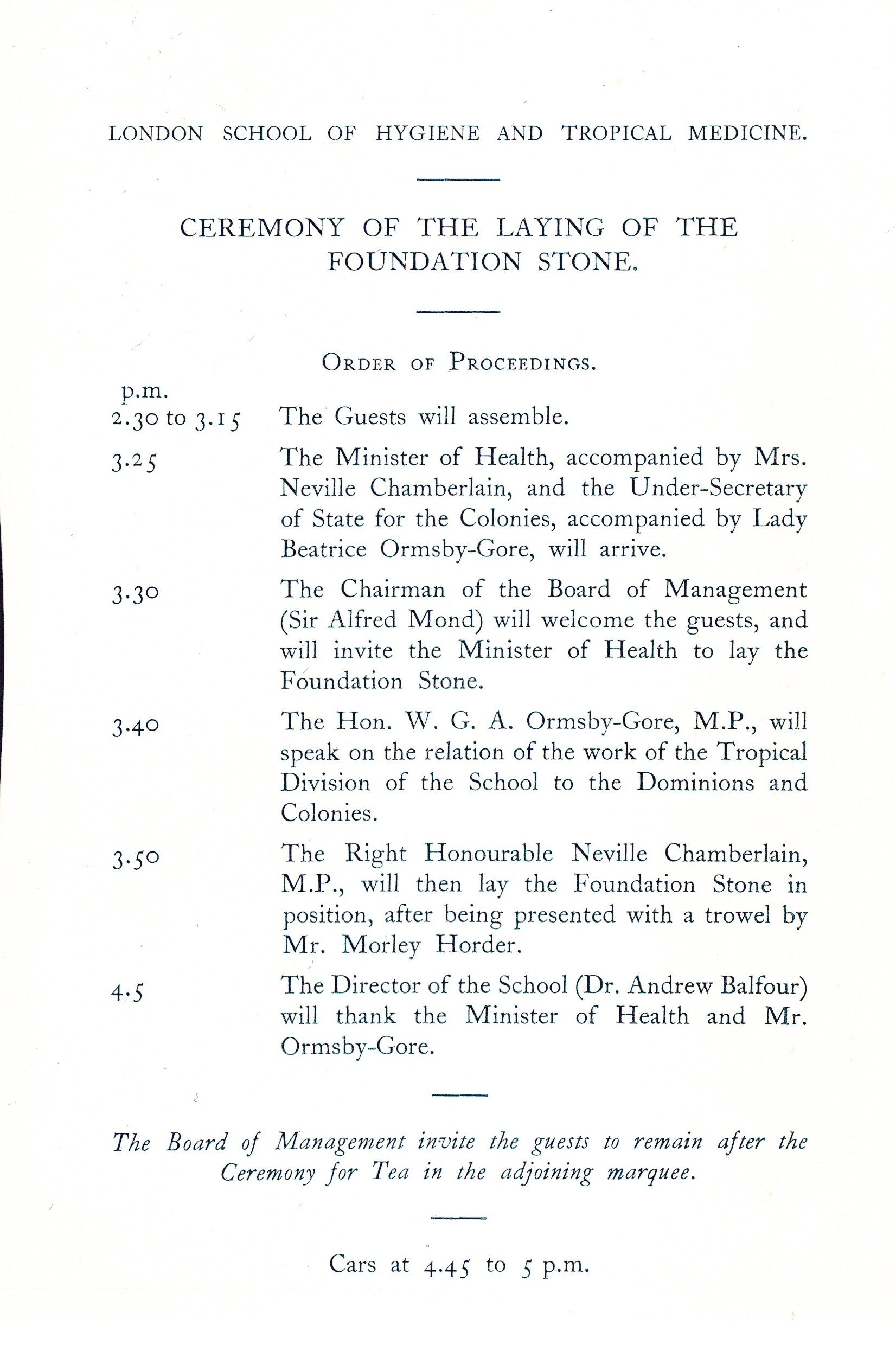
Cover and selected pages from the ‘Order of Proceedings at the Ceremony for the Laying of the Foundation Stone’, featuring a sketch of the final design for the building, the schedule for the event and names of notable speakers. (LSHTM buildings/01/05/01)
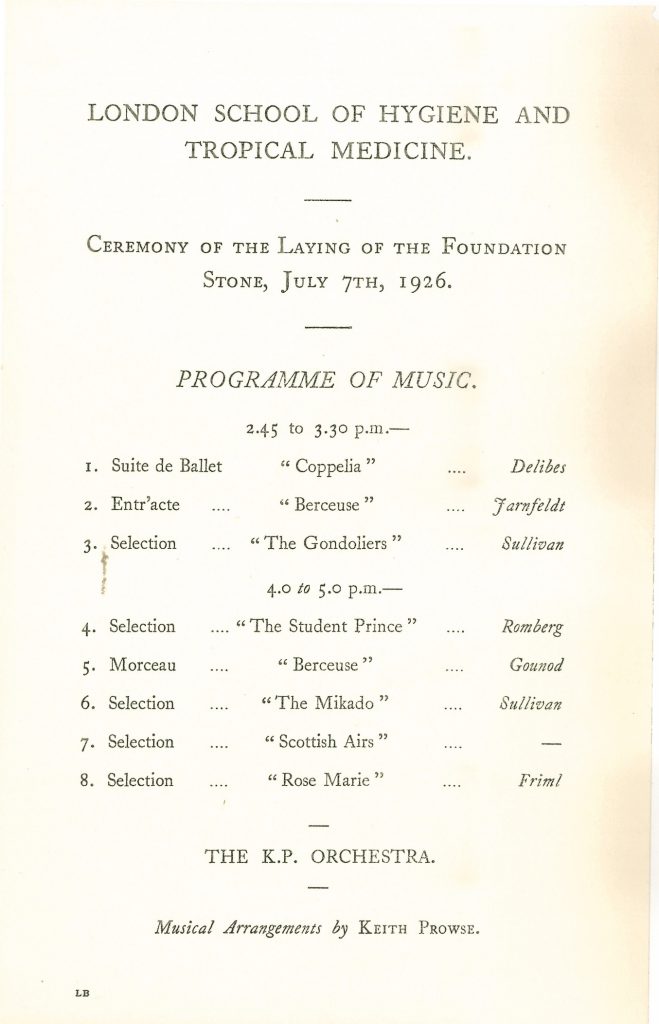

Off-white, typed note stating "London School of Hygiene and Tropical Medicine, ceremony of the laying of the foundation stone, July 7th, 1926. Programme of Music. 2.45-3.30p.m.- 1. Suite de Ballet "Coppelia" Delibes. 2. Entr'acte "Berceuse" Farnfelds. 3. Selection "The Gondoliers" Sullivan. 4-5pm- 4. Selection "The Student Prince" Romberg. 5. Morceau "Berceuse" Gounod. 6. Selection "The Mikado" Sullivan. 7. Selection "Scottish Airs" --. 8. Selection "Rose Marie" Friml. --The K.P. Orchestra. Musical Arrangements by Keith Prowse"

Programme of Music, 1926. 

Orchestral music was provided throughout the event by the K.P Orchestra. Keith Prowse was a famous music publisher. (LSHTM buildings/01/05/01)

A sample of some of the selections is linked below, this was curated by Benedict Long for this exhibition.


Estimate for refreshments, 1926. 

The event also included ‘tea’ and ‘light refreshments’ provided by W. Hill & Son Ltd. This ‘Estimate for Refreshments’ outlines the menu for the day. A subsequent luncheon was also held where selected guests enjoyed a French inspired five course meal at the Carlton Hotel. (LSHTM buildings/01/05/01)
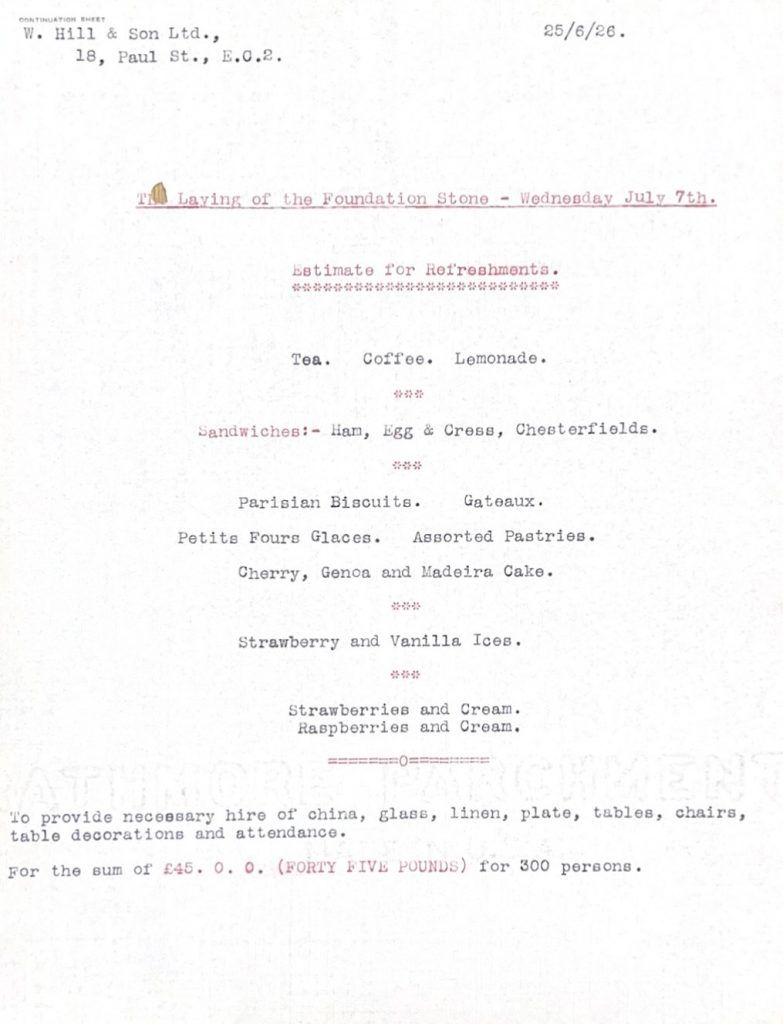
Off-white, typed note stating "The Laying of the Foundation Stone -Wednesday July 7th. Estimate for refreshments. Tea. Coffee. Lemonade. Sandwiches: Ham, Egg & Cress, Chesterfields. Parisian Biscuits. Gateaux. Petite Fours Glaces. Assorted Pastries. Cherry, Genca and Madeira cake. Strawberry and Vanilla Ices. Strawberries and Cream. Raspberries and Cream. To provide necessary hire of china, glass, linen, plate, tables, chairs, table decorations and attendance. For the sum of £45 for 300 persons"

(playlist link will go here, just finishing it) 


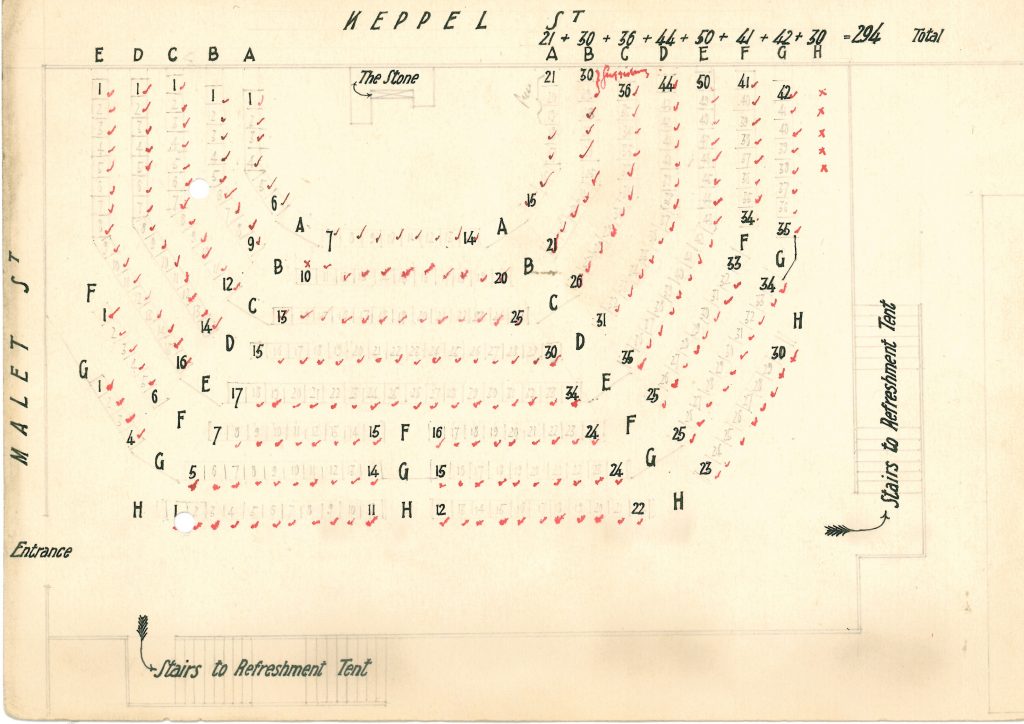
U shaped seating arrangement with check marks confirming which seats had been assigned.
Seating Plan, 1926. (LSHTM buildings/01/05/01)
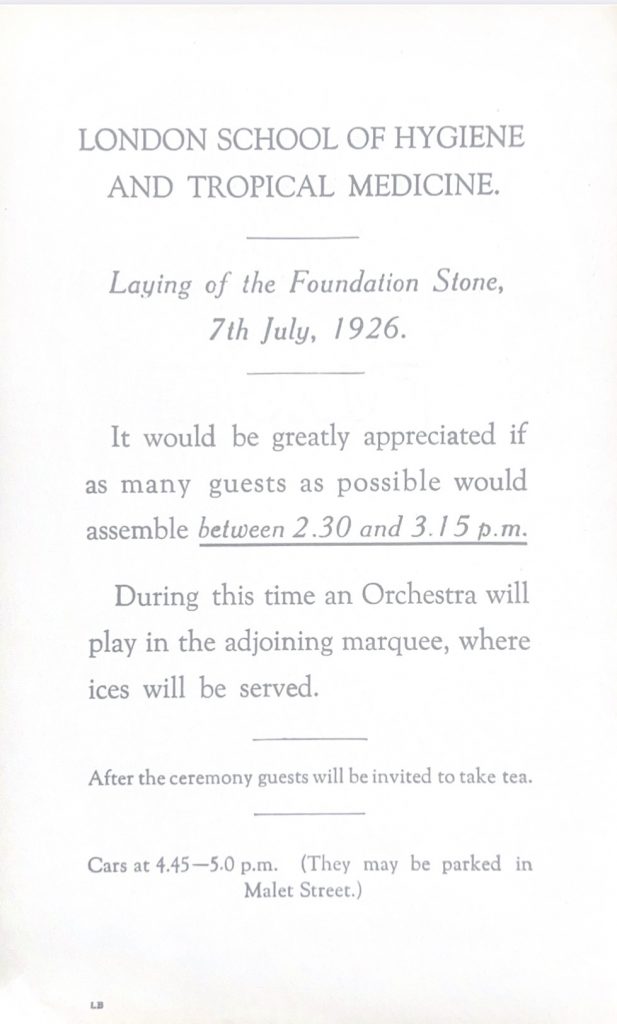
Off-white, typed note stating "London School of Hygiene and Tropical Medicine. laying of the Foundation Stone, 7th July 1926. It would be greatly appreciated if as many guests as possible would assemble between 2.30 and 3.15pm. During this time an orchestra will plat in the adjoining marquee, where ices will be served. After the ceremony guests will be invited to take tea. Cars at 4.30-5pm (They may be parked in Malet Street)"
Notice for the Laying of the Foundation Stone Event, 1926. (LSHTM Buildings/01/05/01)

The Ceremony in the News:

The ceremony was widely reported on across major UK newspapers and the colonies. 
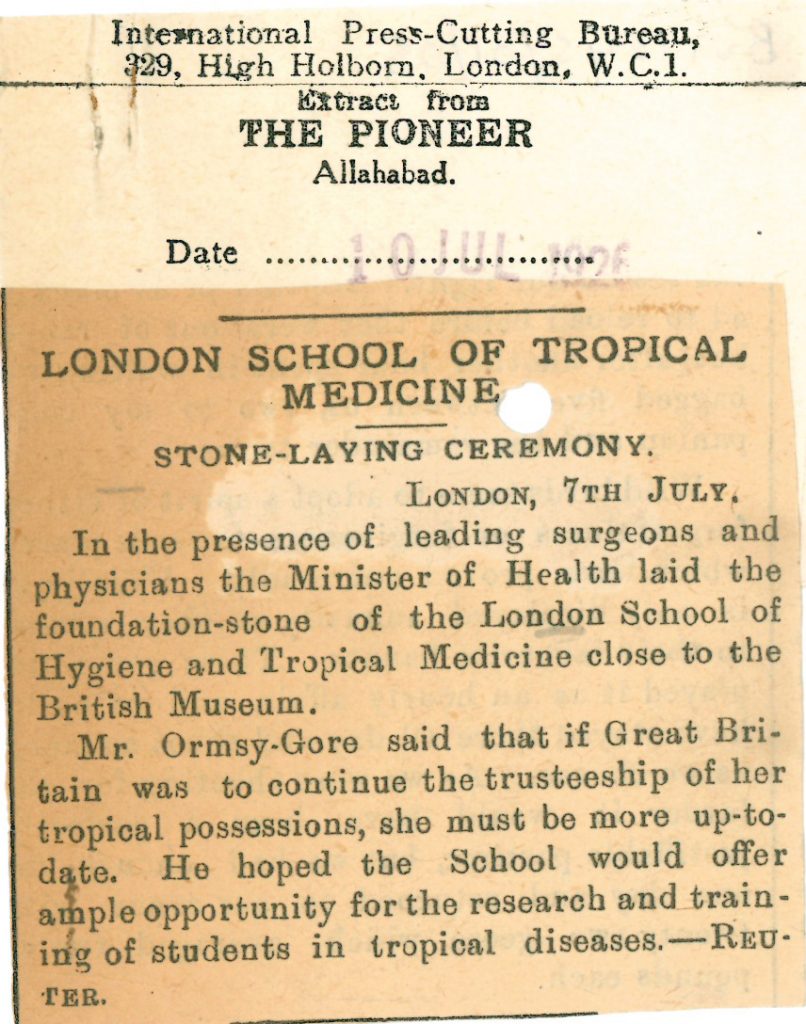
The Pioneer 10th July 1926. London School of Hygiene and Tropical Medicine, Stone Laying Ceremony. London, 7th July
Clipping from The Pioneer, Allahabad, India, 10 July 1926. Mr. William Ormsy-Gore was Under-Secretary for the colonies. (LSHTM buildings/01/05/01)
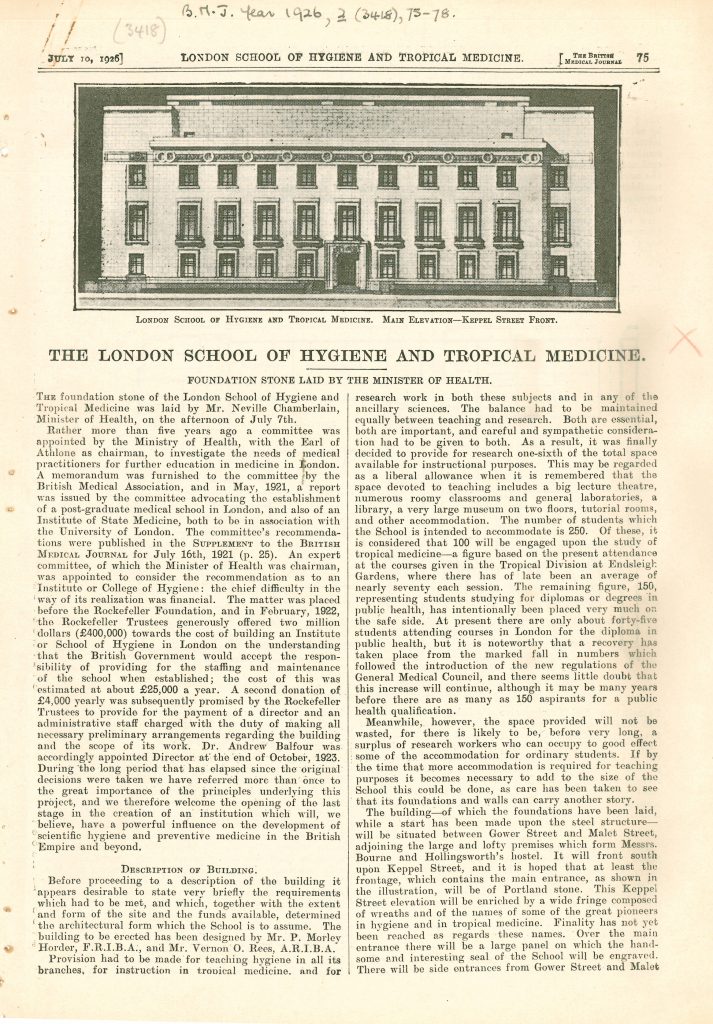
Page from The British Medical Journal, 20th July 1926, details the role of the Rockefeller Foundation and British Government as a State Institute
Page from The British Medical Journal, 20th July 1926 which details the role of the Rockefeller Foundation and British Government in establishing the School as a state institute (LSHTM buildings/01/04/05)

LSHTM Keppel Street Opening Ceremony Invitation, 1929.

After 3 years of construction, the School’s Keppel Street building was officially opened by HRH The Prince of Wales (who went onto become Edward 8th who abdicated), on 18th July 1929 at 12pm.

(LSHTM buildings/01/06/07)
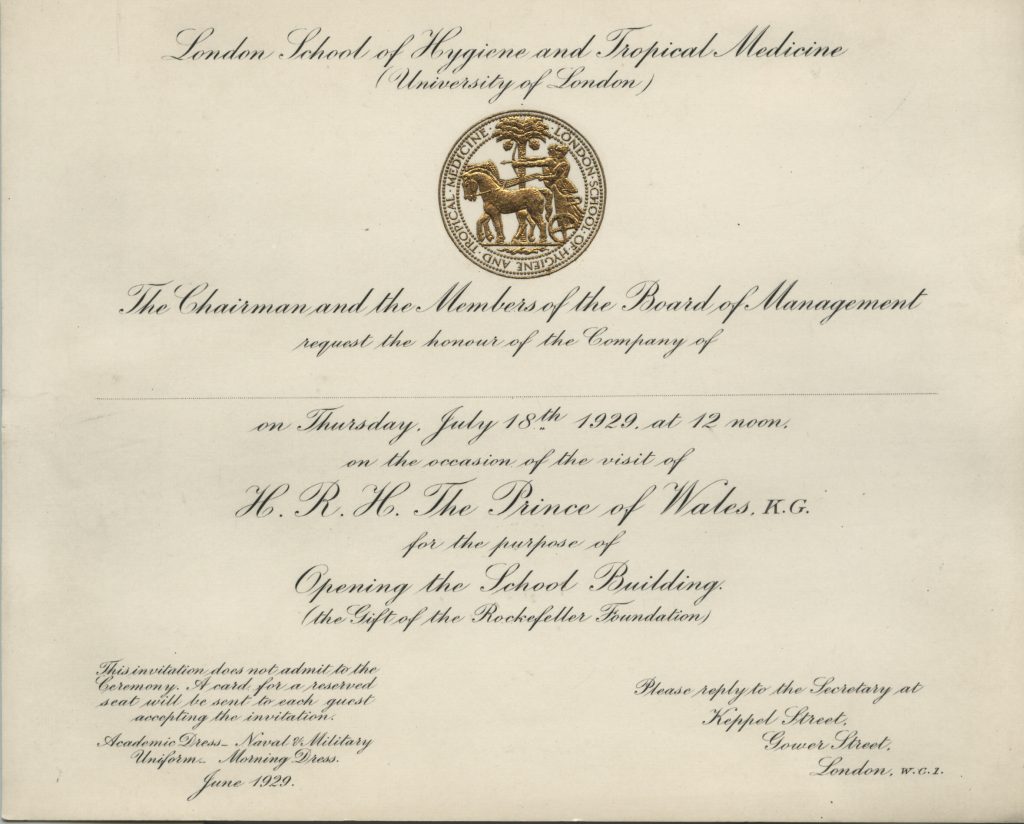
Off-white, cursive invitation with gold LSHTM Logo stating "London School of Hygiene and Tropical Medicine, University of London. The Chairman and the Members of the Board of Management request the honour of the Company of ... on Thursday July 18th 1929 at 12 noon on the occasion of the visit of H.R.H The Prince of Wales, K.G. for the purpose of Opening the School Building (the gift of the Rockefeller Foundation)"

(All images are from the LSHTM Archives Service unless otherwise stated)

Comments are closed.