


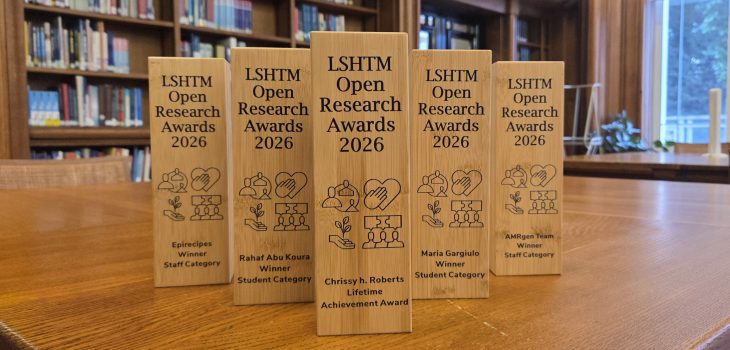
On 7 July, the London School of Hygiene & Tropical Medicine (LSHTM) held its inaugural Open Research Awards as part of the LSHTM Festival.
The awards were intended to recognize and celebrate the amazing work performed by LSHTM students and staff members to advance health research through the use of open methods and practices.
This event represented the culmination of several months work, from the initial proposal through awardee selection. The open research award was formally launched in April 2026, with an open call and ran for six weeks. Individuals or teams could nominate themselves or others by completing a 500-word case study outlining how open methods and practices were applied in a specific context.
Submissions highlighted a range of open research practice, showcasing everything from data and code sharing to community co-production, reproducible methodologies and innovative public engagement. We would like to thank everyone who submitted nominations, as well as the reviewers who contributed their time and expertise to the assessment process.
The Open Research Awards were originally designed to recognise four winners: two research degree students and two staff submissions whose work exemplified outstanding open research practice. However, the exceptional standard of submissions made the judging process particularly challenging. In recognition of the achievements demonstrated across the nominations, the awards panel included an additional Lifetime Achievement Award to recognise sustained contributions to open research, and special recognition for two projects that successfully embedded open research practices in particularly challenging research environments.
AWARD WINNERS
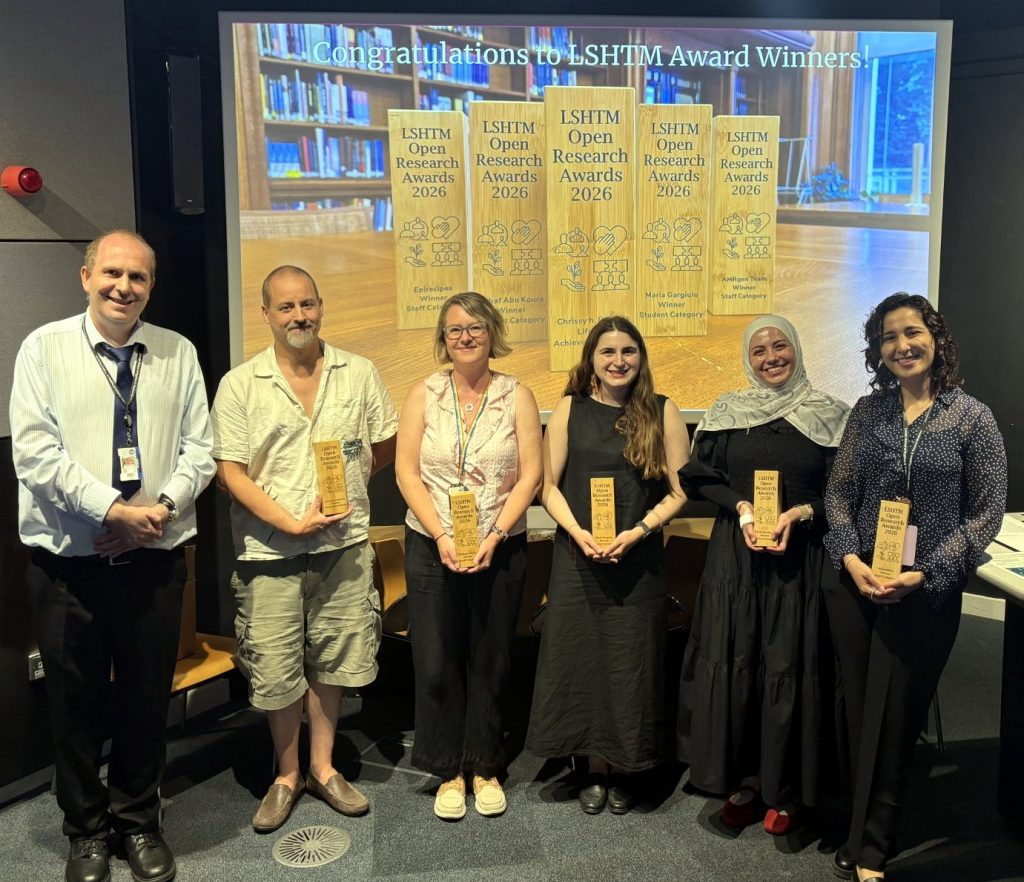
We are delighted to announce the following winners of the inaugural LSHTM Open Research Awards:
LSHTM Research Degree Student Awards
LSHTM Staff Awards
- CAM-Sudan Study team
- Syria Research Group
Congratulations to all of this year’s winners and nominees. Your work highlights the many ways that open research can strengthen health research, improve transparency and reproducibility, and enhance engagement in health research.
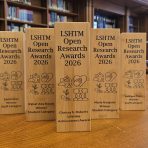
Each winning submission received a presentation piece and a certificate at the event. Additionally, a £50 voucher was awarded to every person included in the submission.
Following the award presentations, winners shared their case studies and experiences of implementing open research practices. Recordings and presentations are available on the Open Research Awards 2026 event page.
CASE STUDIES
Maria Gargiulo – Student Award Winner
Maria Gargiulo is a PhD candidate in the Department of Population Health. Her case study described work in her dissertation project, “Guerra de cifras and cifras de guerra: Essays on data quality and conflict mortality in Latin America”, which uses quantitative methods to examine homicide mortality. The project is composed of multiple studies of conflicts in Colombia, Guatemala, and Mexico. A key area of her work is to explore how the data quality issues that emerge in conflict settings.
A theme presented in Maria’s case study was the need to balance openness with confidentiality to ensure the rights of vulnerable populations are protected. While raw data cannot be shared, it remains possible to perform research in a way that is transparent, auditable, and replicable.
A key aspect of her research workflow is the use of principled data processing, to separate analyses into distinct tasks. Each task is then carried out using code written with open-source programming languages, such as R, version controlled (even when working alone) and run with Makefiles/meta-files to ensure code is run in the intended order.
To support publications associated with her dissertation, research code is uploaded to the Open Science Framework (OSF) repository and shared with reviewers upon submission using view-only links to preserve anonymity. Once the paper is accepted, the links can be replaced with citable resources.
Rahaf Abu Koura – Student Award Winner
Rahaf Abu Koura is a PhD candidate in the Department of Infectious Disease Epidemiology and International Health. Her case study, titled “Practising what the research preaches: Open research in an evidence map of humanitarian mortality data”, examines what population-level mortality data are available and how informative they are in humanitarian crises for the period 2018–2025.
A key aspect of her research is to map the mortality information available across humanitarian crises and, crucially, to reveal where it is missing: the settings in which the deaths of crisis-affected populations go uncounted. This consideration led her to build openness into each stage of her own work – an approach that she considers to have enhanced the integrity and rigour of her work. The pre-registration of her research protocol on the Open Science Framework required her to make decisions and resolve ambiguities that might have been deferred, as well as opened her protocol to feedback from the wider research community.
The research draws on mortality data obtained from a range of sources and produced to different standards and formats. To screen, extract and analyse these data, Rahaf has developed an analytic workflow in R and an R Shiny application that will enable others to access, understand, and use the data for their own research. Once work is complete, the underlying data and code will be made available in a GitHub repository under an open licence.
AMRgen team – Staff Award Winner
The first Open Research Award for Staff was presented to Professor Kathryn Holt, representing the AMRgen team, for their work developing an R package for antimicrobial resistance (AMR) genotype–phenotype analysis. The AMRgen team included Professor Kathryn Holt, Gwen Knight, Ebenezer Foster-Nyarko, Zoe Dyson, and Kara Tsang from LSHTM, and several external collaborators.
The AMRgen R package and accompanying web application were developed to address a major gap in AMR research: the lack of standardised, open-source tools for analysing relationships between bacterial genotypes and antimicrobial susceptibility phenotypes. Its rapid development and successful release were driven by a collaborative model that enabled contributions from researchers, clinicians, and public health professionals. This ensured that development was guided by real user needs rather than the assumptions of a small development team.
In the spirit of openness, development of the AMRgen tool began at a hackathon hosted by LSHTM in January 2025. During the event, participants worked together to design the package architecture, define analytical approaches, and develop the initial functions. A public GitHub repository was created to host the code generated at the hackathon, and development continued openly from that point onwards, with contributions actively encouraged from the wider community. By late 2025, the project had evolved into a fully developed package with extensive documentation and user vignettes. The first AMRgen release, together with a preprint describing the package, was published in May 2026.
A key feature of AMRgen is its ability to import phenotype data from a range of commonly used formats and export it into a format suitable for submission to the International Nucleotide Sequence Database Collaboration (INSDC). This helps reduce barriers to sharing AMR phenotype data, making these valuable datasets more accessible to other researchers. The team also developed a web application powered by AMRgen enabling users to perform data conversion through a simple browser-based interface, without the need to install R or have specialist coding expertise.
Epirecipes team – Staff Award Winner
The second Open Research Award for Staff was presented to Dr. Sandra Montes-Olivas, representing EpiRecipes, for their work on an open-source toolkit to help researchers build, test, and improve infectious disease models more quickly and transparently. The EpiRecipes development team includes Simon Frost, Sam Abbott, and Sebastian Funk, as well as collaborators, Ashley Akbari and Michael Gravenor at Swansea University.
The EpiRecipes toolkit was developed to address a specific challenge in epidemic modelling: models are often created on a case-by-case basis, making them difficult to understand, update, or reuse during a rapidly evolving outbreak. To overcome this challenge, the Epirecipes toolkit builds on a mathematical framework known as Applied Category Theory. This approach separates the modelling process into smaller, interchangeable components that can be designed, selected, and combined as needed, eliminating the need to rebuild a model from scratch each time. Instead, a number of open-source tools can be integrated into a single workflow. These include components for policy optimisation (NLP), model fitting to case data (DDSA), contact structure (ContACT.jl), and interventions (CategoricalInterventions.jl).
A key aspect of the case study was the importance of openness in developing a modular toolkit. By building on open-source tools and models, users can understand how information is entered, processed, and generated at each stage of the workflow. This transparency also enables contributions from developers with expertise in specific areas, supporting ongoing improvement and collaboration.
Further details on Epirecipes may be found in their PLOS Computational Biology paper, “Exploring epidemic control policies using nonlinear programming and mathematical models”.
Professor Chrissy h. Roberts – Lifetime Achievement Award
A Lifetime Achievement Award was also presented to Professor Chrissy h. Roberts for his work in advancing digital data collection methods at LSHTM.
At a time when many studies still relied on paper questionnaires, he recognized that tools such as Open Data Kit (ODK) could transform the way data was collected in the field. Through his leadership, LSHTM established a centrally supported ODK service in 2013, creating a foundation that enabled researchers and students to confidently apply digital data collection across a wide range of settings.
Under his stewardship, the LSHTM ODK service has supported more than 500 research projects, providing training and guidance on study design and data management to a range of LSHTM users, from MSc students conducting their first field study to major international collaborations operating across multiple countries. He has also contributed to the wider ODK community through technical leadership and the development of features supporting clinical trials and emergency response activities. His contribution has quietly underpinned hundreds of successful health studies around the world.
Special Mentions
The Open Research award panel also wishes to recognize the following research teams that have demonstrated a commitment to open research while working in particularly challenging environments.
Making Invisible Deaths Count: Open and Reproducible Mortality Estimation During Sudan’s War
CAM-Sudan Study: Maysoon Dahab, Catherine McGowan, Rahaf Abu-Koura, Nada Abdelmagid, & Francesco Checchi.
Democratising health research in conflict: participatory methods, open dissemination, and capacity-strengthening with the Syria Research Group
Syria Research Group: Mervat Alhaffar, Natasha Howard,Yazan Douedari, and colleagues.
