Amolak Ram Mehta was born in a village near Lahore in 1894 in what is now the Punjab Province of Pakistan. He studied medicine at King Edward Medical College in Lahore before travelling to England in 1920 to further his medical education. His journey by sea from India, reflections on studying at LSTM and observations of London life in the 1920s are described in some detail by his son, the writer Ved Mehta.
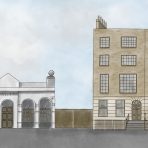
“Daddyji [Ved Mehta’s name for his father] could afford to stay only a year in England, and so, without the knowledge of the university authorities, he began working simultaneously in two institutions – University College, for the Diploma in Public Health, and the London School of Tropical Medicine, for the Diploma in Tropical Medicine and Hygiene. … The two schools were … quite close to Shakespeare Hut [a YMCA (Young Men’s Christian Association) building with accommodation erected on the grounds of what is now the LSHTM – originally for servicemen serving in WW1], and he devised a system of going in the morning, after a light breakfast, to University College, getting himself marked present, and then dashing over to the School of Tropical Medicine, where he would spend the rest of the day working in the laboratories. … He would have a frugal dinner in the dining room of Shakespeare Hut and spend the evening studying.”
“Daddyji became a protégé of one of his lecturers at the School of Tropical Medicine – Dr Louis Westenra Sambon, an Italian, who was associated with the discovery that malaria is carried by anopheles mosquitoes. … One evening, he invited Daddyji to his house for dinner … Dr. Sambon introduced Daddyji to his wife … and to his three young daughters, … .” (Mehta, V., 1984: 58-61).
The LSHTM register shows that when Dr Mehta arrived in 1920 he qualified for MB.BS Punjab (Hons) and joined the School’s 64th session. He passed the Diploma in Tropical Medicine (Lond) with 61%, and he also gained a DPH Lond. After graduation he returned immediately to India.
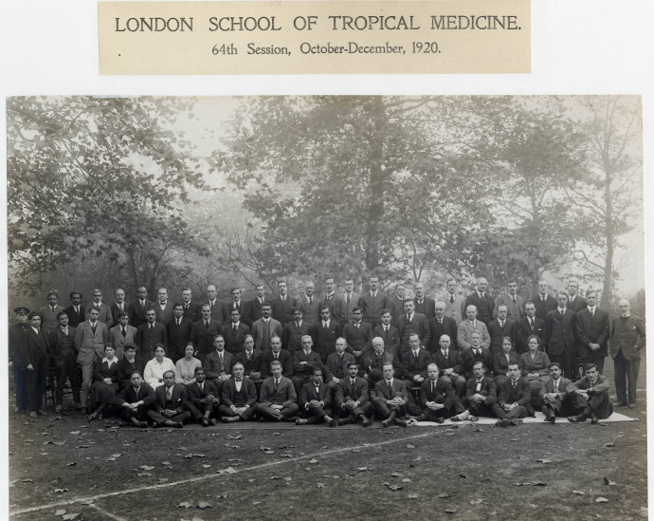
Amolak can be seen in the front row, seventh from the right.
A key to the names of all the staff and students in the photograph can be found here: https://discover.lshtm.ac.uk/discovery/fulldisplay?docid=alma991000698346503736&context=L&vid=44HYG_INST:44HYG_VU1&lang=en&search_scope=MyInst_and_CI&adaptor=Local%20Search%20Engine&tab=Everything&query=any,contains,amolak%20ram%20mehta&offset=0
Dr Mehta was appointed to the public health department of the Punjab in Rawalpindi in 1921 then under the British Raj but took a two year break in 1923 to study public health and tropical medicine in Europe and the US on a Rockefeller Foundation Traveling Fellowship. After partition in 1947, he relocated to become director of the Public Health Department of the East Punjab in independent India. One of his last appointments was Director General of Health Services and Minister of Health in Prime Minister Jawaharlal Nehru’s Cabinet. He retired in 1951. He died in 1986 in New Delhi aged 91.
Dr Mehta is credited with successfully bringing several medical emergencies under control, including a severe outbreak of bubonic plague in Rawalpindi. From 1931-1937 he was working in Delhi with the King George Thanksgiving Fund Committee, established to fight tuberculosis. After 1947 he was involved with improving health care in refugee camps set up for Hindu and Sikh families fleeing their homes in newly created Pakistan and crossing the border into India.
After retirement he participated in a World Bank mission to Ceylon (now Sri Lanka) and wrote a report on the health of the country. In 1952 he was a visiting Fulbright Professor at the University of California Los Angeles Medical School. In 1952 he wrote a prize-winning essay “Population control in relation to food in India” especially aimed at the poor in India.
Dr Mehta’s son, Ved Mehta (1934-2021), who became blind in childhood, was a well-known writer and the author of several books and a regular contributor to The New Yorker Magazine. His biography of his father and mother, Daddyi-Mamaji contains no references, and it must be assumed that Amolak Mehta left extensive diaries from which the extracts are reprinted.
References
KREBS, A., 1986. Amolak Ram Mehta, 91, dies: former Indian health official. The New York Times 29.7.1986. https://www.nytimes.com/1986/07/29/obituaries/amolak-ram-mehta-91-dies-forme-indian-health-official.html (viewed 7/7/2026)
MEHTA, A.R., 1953. Population control in relation to food in India. Los Angeles, CA: The Watumull Foundation. https://www.saada.org/explore/archive/items/20141106-3872#:~:text=A.R.%20Mehta%20and%20excerpts%20from,ADDITIONAL%20METADATA (viewed 29/7/2026)
MEHTA, V., 1984. Daddyji -Mamaji. London : Pan Books Ltd (Picador edition).
LSHTM Library Rare Books Collection Blogs is an occasional posting highlighting books that are landmarks in the understanding of tropical medicine and public health. The Rare Books Collection was initiated by Cyril Cuthbert Barnard (1894-1959), the first Librarian, from donations and purchases, assisted with grants from the Carnegie United Kingdom Trust. There are approximately 1600 historically important rare and antiquarian books in the Rare Books Collection.
Many of the LSHTM Library’s rare books were digitized as part of the UK Medical Heritage Library. This provides high-quality copyright-free downloads of over 200,000 books and pamphlets for the 19th and early 20th century. To help preserve the rare books, please consult the digital copy in the first instance.
If the book has not been digitized or if you need to consult the physical object, please request access on the Library’s Discover search service. Use the search function to find the book you would like to view. Click the title to view more information and then click ‘Request’. You can also email [email protected] with details of the item you wish to view. A librarian will get in touch to arrange a time for you to view the item.
Researchers wishing to view the physical rare books must abide by the Guidelines for using the archives and complete and sign a registration form which signifies their agreement to abide by the archive rules. More information is available on the Visiting the Archives webpage.
