



Bachera Aktar’s research shows how people in informal settlements in Dhaka, Bangladesh, access public health services through local networks and community relationships, and how these arrangements can both help address and deepen existing inequality.
When formal health systems do not reach everyone, people often rely on personal relationships and informal networks within their communities to access essential services, for example, water and healthcare. These arrangements can help communities overcome gaps in public services, but they can also create new barriers for people without strong social or political connections.
A new study led by Dr Bachera Aktar examined how public health services are delivered and accessed in two informal urban settlements in Dhaka, the capital of Bangladesh and one of the fastest-growing and densely populated megacities. The research found that in the absence of state-led formal public health services, health governance in these communities is shaped by complex and fluid relationships between formal authorities, local government representatives, community leaders, NGOs, private providers and residents.
The paper introduces a new ‘Multi-layered Hybrid Governance’ framework to explain how these different actors interact, intersect and influence access to public health services in politically charged informal urban spaces. The framework shows that governance in informal settlements is not simply a dichotomy between formal and informal. Instead, it operates through overlapping systems of negotiated authority, community relationships and local power structures.
The researchers found that the positions and roles of different actors can change over time depending on local situations. Community leaders and local elected representatives may act as important links between residents and formal authorities, while NGOs can act as intermediaries and service providers. Residents may also move between being service users and active local governance agents, depending on the context.
These arrangements can demonstrate community resilience. Where formal systems are unable to meet residents’ needs, collaboration between communities, NGOs and public authorities can help people access essential services. The study highlights examples including efforts to secure legal piped water connections, community-led emergency funds to help residents pay for healthcare, and informal referral systems that helped people access free or reduced-cost maternal and child health services.
However, the research also found that the same systems can reinforce inequalities. Access to support may depend on political connections, social networks or relationships with influential community leaders. This means that residents without strong connections, including some newer migrants, may face greater difficulties accessing services.
The study also highlights the fragile nature of informal relationships and arrangements within these systems. Collaboration does not always depend on trust or shared goals. Instead, actors may work together because of practical interests or mutual dependence, meaning that relationships can change when those interests change.
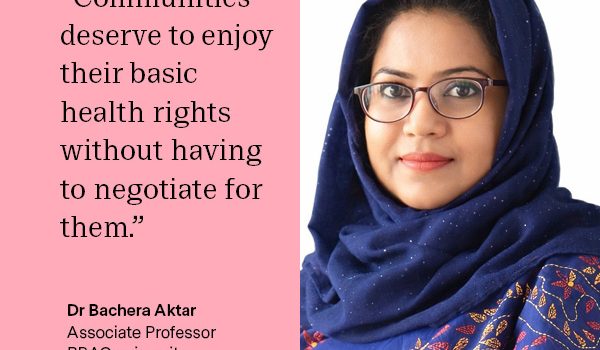
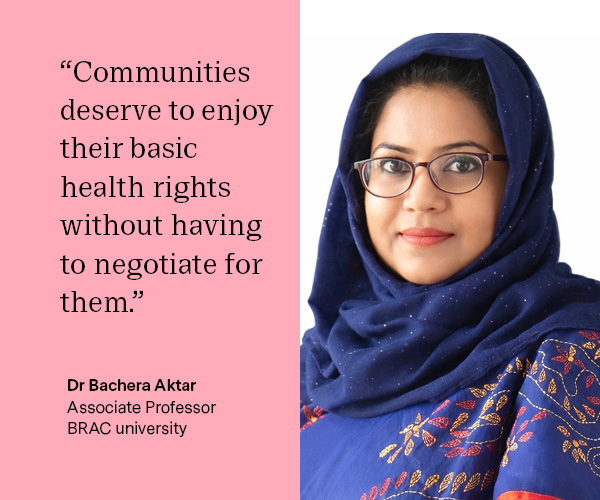
Dr Bachera Aktar, Associate Professor and Deputy Director of the Center of Excellence for Gender, Sexual and Reproductive Health Rights at BRAC James P. Grant School of Public Health (JPGSPH), BRAC University, said: “Community resilience should not be a substitute for state responsibility. Communities deserve to enjoy their basic health rights without having to negotiate for them. Informal settlements should not be viewed as governance voids, but as vibrant spaces of existing governance that need recognition, support, and accountability.”
The findings highlight the importance of recognising the informal networks that many communities rely on to access essential public health services, while also addressing the power imbalances and lack of accountability that can make these systems unequal.
The researchers argue that policymakers and health service providers should look beyond conventional models of health governance and learn from the experiences of people living in informal settlements. Understanding how services are actually accessed and negotiated can help develop health systems that are more inclusive, resilient and sustainable.
The paper, Hybrid Governance: Negotiating justice for health services in informal urban settlements in Dhaka, Bangladesh, is part of a Health Policy and Planning supplement produced in collaboration with the Health Systems Global (HSG) community. The supplement explores how health policy and systems research can contribute to greater justice and sustainability in health systems.
Listen to the full podcast featuring Dr Bachera Aktar