





Research across 75 low- and middle-income countries shows how school-based health programmes could improve education while generating substantial health and economic benefits
Investing in school-based health programmes could deliver benefits that extend well beyond improvements in young people’s health, according to research published in Health Policy and Planning.
The study shows how health and education can reinforce one another, with better health supporting educational attainment and additional years of schooling contributing to longer-term health and economic benefits.
Researchers modelled four school-based interventions across 75 low- and middle-income countries: nutrition, deworming, water, sanitation and hygiene (WASH), and mental health programmes. They estimated the costs and potential returns of investing in these interventions between 2025 and 2050.
The modelling suggests the interventions could contribute to more than 422 million additional school completions and generate over US$15.3 trillion in economic benefits. This represents an estimated return of around US$7 for every US$1 invested.
When researchers also accounted for longer-term health benefits associated with increased education, estimated benefits rose to more than US$25.2 trillion, increasing the benefit-cost ratio to approximately US$11.50 for every US$1 invested.
The study also considered how staying in education for longer can influence health later in life. This included reductions in adolescent pregnancy associated with increased years of schooling and subsequent reductions in under-five and adult mortality.
The researchers found that some of the largest economic benefits come not only from additional years of schooling, but also from more people surviving to working age and contributing to the labour force.
The findings highlight the potential value of considering health and education together when designing policies for young people, rather than treating them as separate areas of investment.
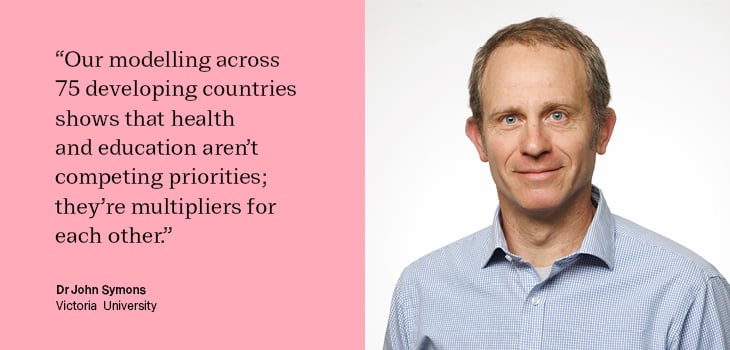
Dr John Symons, lead author of the study, said: “”Our modelling across 75 developing countries shows that health and education aren’t competing priorities—they’re multipliers for each other. Integrated investment in school health programs could unlock over $25 trillion in economic benefits by 2050, with returns of more than 11 dollars for every dollar spent. The evidence is clear: policymakers who treat health and education as separate budget lines are leaving enormous value on the table.”
The researchers note that the modelling does not capture every potential benefit. For example, it does not estimate the immediate economic value of improvements in health from the interventions and may not fully capture wider social benefits such as greater equality and civic engagement.
The study provides evidence for more coordinated approaches to health and education policy, with the authors arguing that integrated investment could help countries maximise benefits for young people, wider society and the economy.
The research is published as part of the Health Policy and Planning supplement, New Perspectives on Advancing Adolescent Health and Well-being, which brings together six papers exploring approaches to improving adolescent health and well-being.